


Share:
The Chinese Language Center of Feng Chia University, in collaboration with the Taipei Feng Chia University Alumni Cultural Foundation and co-organized by the Library, hosted the First “Light Knowledge, Little Diamond” AI-Assisted Popular Knowledge Video Storytelling Competition. An award ceremony and exhibition of winning works were held at the Library on June 25. Guests included Yao-Jen Hsiao, Dean of the College of Humanities and Social Sciences; Shu-Yuan Chou, Chairperson of the Taipei Feng Chia University Alumni Cultural Foundation; alumni Yu-Hsien Lu and Chun-Tang Chou, who joined to celebrate students’ interdisciplinary achievements combining AI tools, language skills, and professional knowledge.
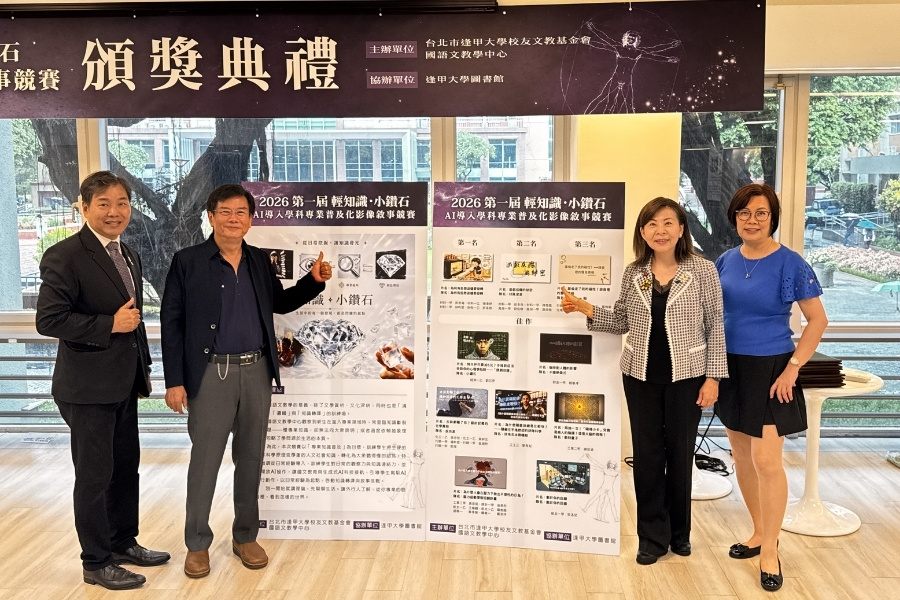
Yao-Jen Hsiao (second from left), Dean of the College of Humanities and Social Sciences, Shu-Yuan Chou (second from right), Chairperson of the Taipei Feng Chia University Alumni Cultural Foundation, together with alumni Chun-Tang Chou (left) and Yu-Hsien Lu (right), attend the award ceremony and exhibition opening of the “Light Knowledge, Little Diamond” Competition on June 25.
A total of 143 teams comprising 524 students participated in this year’s competition. Entries came from a wide range of disciplines, with approximately 47.3% from engineering and technology-related fields, 19.5% from business-related disciplines, and 33.2% from humanities, design, architecture, and other areas. The competition demonstrated broad cross-disciplinary engagement in knowledge communication.
The competition aimed to promote the public communication of specialized knowledge. Students were challenged to transform complex scientific principles and humanities or social science concepts into engaging three- to five-minute videos accessible to general audiences. A key requirement was to start from everyday experiences, reorganizing professional knowledge into narratives that non-specialists could easily understand. The goal was not merely to simplify knowledge, but to bridge disciplinary boundaries through effective storytelling and language expression.
Among the 143 submissions, topics explaining everyday phenomena proved most popular. Psychology and behavioral science-related themes ranked first, followed by engineering and technology, brain science, and neuroscience. Topics ranged from “Why Do Microwave Ovens Need to Rotate?” and “Why Do People Become Addicted to Video Games?” to “Can Silver Needles Really Detect Poison?”. These projects began with familiar questions and applied academic knowledge to provide answers, embodying the spirit of making knowledge accessible through daily-life inquiry.
Another distinctive feature of the competition was students’ use of multiple AI tools throughout the creative process. Rather than relying on a single platform, participants explored AI applications for topic development, research organization, scriptwriting, image generation, voiceovers, and video editing. Through this process, they developed their own AI-assisted workflows and strengthened their ability to integrate emerging technologies into learning and communication.
The first-place entry, “Why Do Some Microwave Ovens Need to Rotate?”, started with a common household question and guided viewers through the principles of even heating before introducing concepts such as electromagnetic waves and standing waves. By combining relatable questions, animated visuals, and step-by-step explanations, the project successfully transformed abstract engineering concepts into content understandable to audiences without technical backgrounds, demonstrating both scientific accuracy and outstanding knowledge translation skills.
The Chinese Language Center noted that the competition was designed to cultivate students’ interdisciplinary communication, multimodal expression, and public engagement abilities. By leveraging language skills and AI technologies, students learned how to share specialized knowledge with broader audiences. The exhibition of winning works will remain on display through the end of August, and all faculty members and students are welcome to visit.
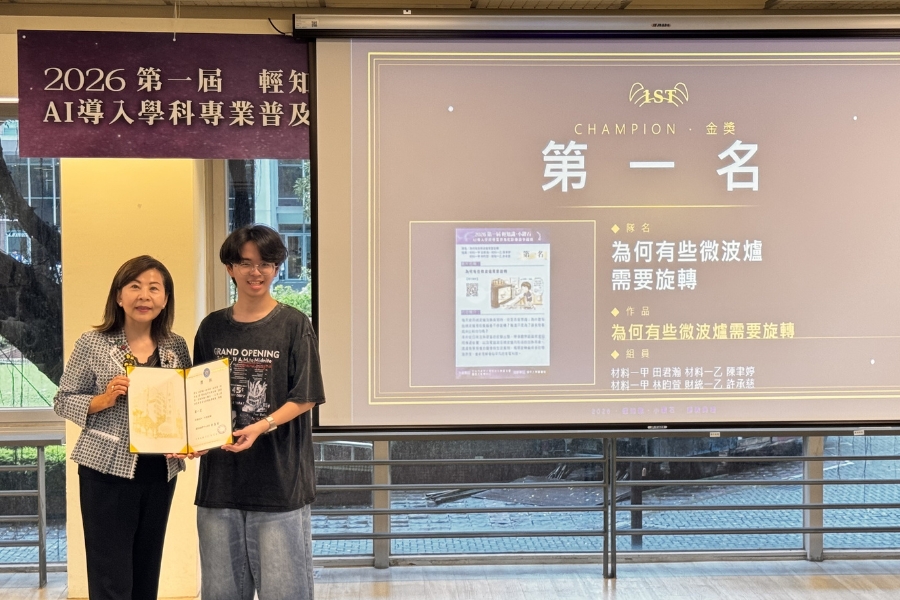
Shu-Yuan Chou, Chairperson of the Taipei Feng Chia University Alumni Cultural Foundation, presents the first-place award certificate to the representative of the winning team from the Department of Materials Science and Engineering.
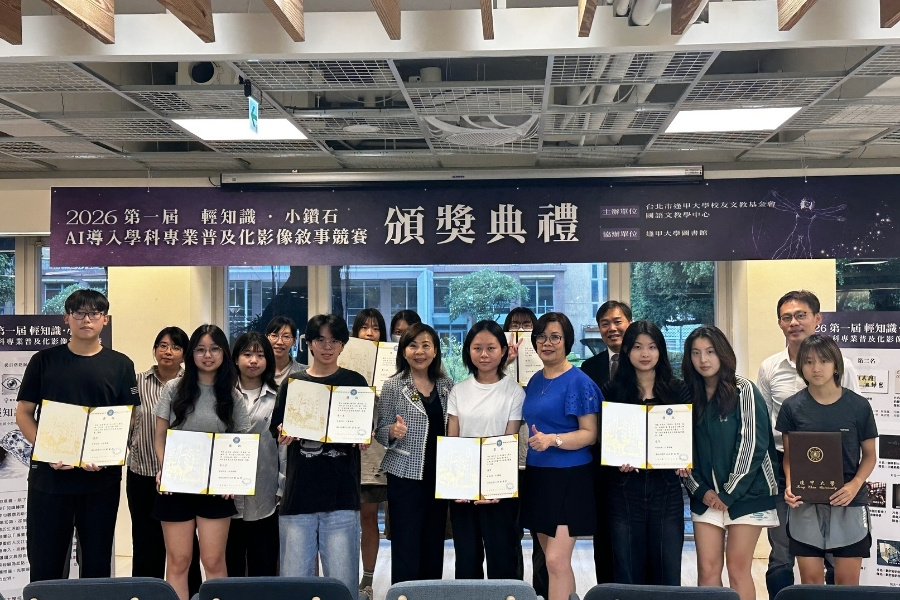
Award-winning student teams of the “Light Knowledge, Little Diamond” Competition pose for a group photo with faculty members and alumni.
Share:
Related News