


Share:
The College of Construction and Development at Feng Chia University hosted the 2026 AEC Digital Prototyping and Geographic Information System (GIS) Competition on June 7. Supported by the Ministry of Education's Project on Experimental and Constructive Approaches for New Engineering Education, the competition was built upon two courses—AEC Digital Prototyping and Geographic Information Systems (GIS)—and encouraged students to transform classroom learning into practical solutions.
Integrating spatial information technologies, data analytics, and digital tools, participants developed innovative proposals addressing challenges related to smart cities, transportation, environmental sustainability, and urban governance. From problem identification and data collection to spatial analysis and final presentations, teams demonstrated strong interdisciplinary collaboration and problem-solving abilities.
To strengthen industry engagement, the competition invited experts from government, industry, and academia to serve as judges. The panel included Chao-Fu Yeh, Director-General of the Transportation Bureau of the Taichung City Government; Yi-Heng Meng, Director of the Software Technology Institute at the Institute for Information Industry; and Lan-Kun Chung, General Manager of Singularity Infinity Co., Ltd. The judges evaluated projects from the perspectives of public governance, industry practice, and technological innovation while providing valuable professional feedback.
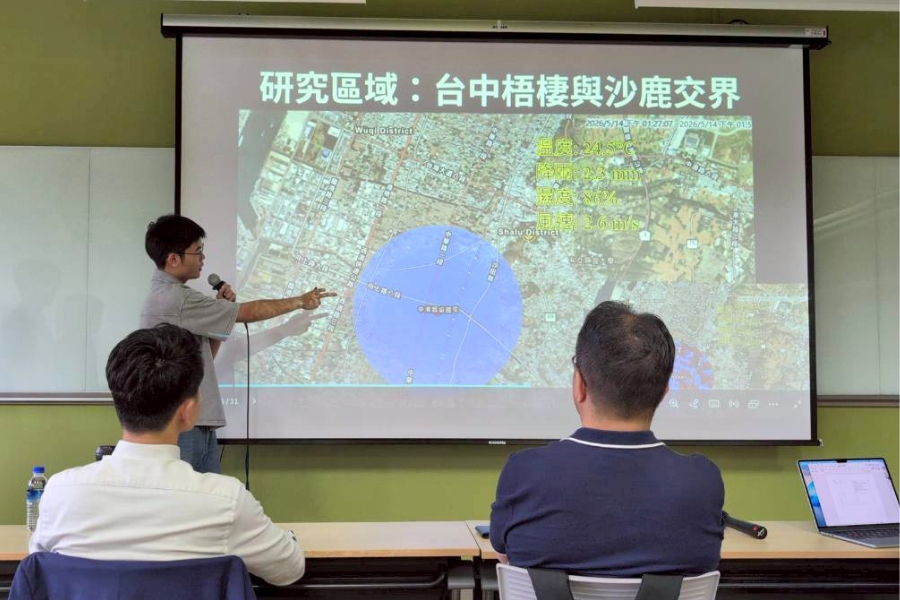
Student teams presented their projects and solutions to the judging panel throughout the competition.
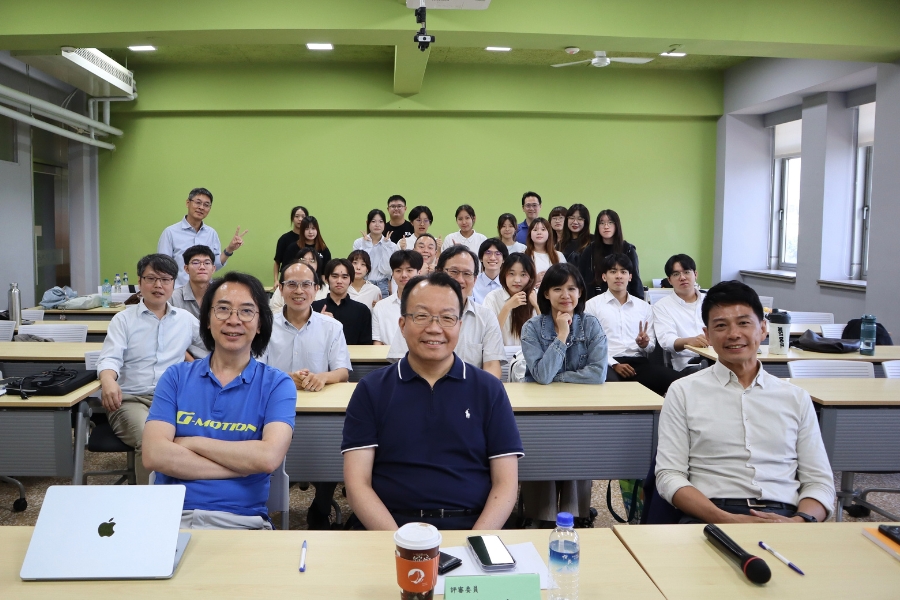
All participating students pose for a group photo with industry judges Chao-Fu Yeh, Director-General of the Transportation Bureau of the Taichung City Government; Yi-Heng Meng, Director of the Software Technology Institute at the Institute for Information Industry; and Lan-Kun Chung, General Manager of Singularity Infinity Co., Ltd.
The championship-winning team, Three Make a Tiger, consisted of three students from the Department of Civil Engineering. Their project, LaundryMaster, received unanimous praise from the judges. The smart campus laundry management system utilizes non-intrusive AI-powered visual recognition to address three major dormitory laundry room challenges: peak-hour waiting times exceeding 30 minutes, machines left occupied by completed loads, and user disputes caused by information asymmetry.
The system incorporates external AI camera nodes to detect machine status without modifying existing hardware or transmitting images. Students can remotely check machine availability and make reservations through a mobile app, while administrators can automatically identify anomalies and monitor overdue machine usage.
Second place went to Fei Fei Wei Wei 300 Days, a team from the Department of Transportation and Logistics, for its project Suitability and Demand Analysis of the Hualien High-Speed Rail Corridor. Third place was awarded to Concrete Jungle Intelligence Agency, a team from the Department of Water Resources Engineering and Conservation, for FCU Heat Escape Challenge: Finding 2°C of Freedom in the Concrete Jungle.
Honorable Mention awards were presented to:
Black Dog Gang — Campus Navigation System: Real-Time Drainage and Dry-Route Prediction Using ArcGIS Pro and PythonTrue Love Salted Fish — Customized Road Network Risk Query System for Yangmingshan National Parkgogogo — Green Network Transformation: Urban Heat Island Mitigation and Park Carbon Reduction Simulation in Taichung
The award-winning projects addressed a diverse range of topics, including transportation infrastructure, campus environments, mountain-area safety, and urban sustainability.
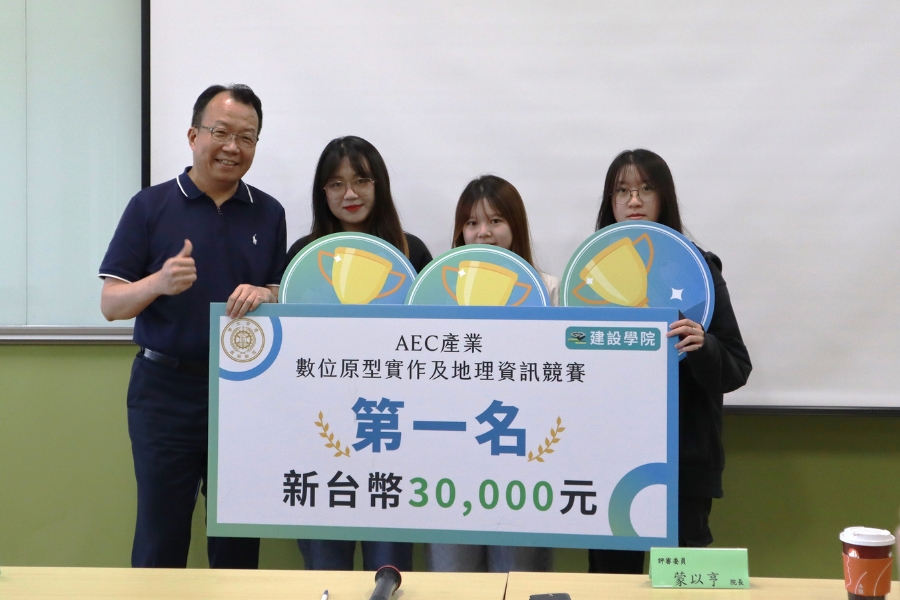
The team "Three Make a Tiger" won first place with its smart campus laundry management system, LaundryMaster.
The College of Construction and Development noted that the competition's greatest achievement was seeing students actively apply classroom knowledge to real-world challenges. From dormitory laundry management and high-speed rail planning to campus heat island mitigation and mountain transportation networks, digital technologies became practical tools for solving genuine problems rather than merely academic exercises.
Looking ahead, the College will continue leveraging resources from the Ministry of Education's New Engineering Education initiative to advance curriculum innovation and hands-on learning, cultivating a new generation of engineering professionals equipped with digital expertise, interdisciplinary integration capabilities, and practical problem-solving skills.
Share:
Related News