


Share:
The Chinese Language Teaching Center at Feng Chia University hosted the 5th Conference on Constructing and Reflecting Chinese Language Teaching on May 23 under the theme“Digital Transformation × AI Co-Learning: Future Perspectives for Chinese Language Education.” Co-organized by the National Science and Technology Council’s Center for Humanities and Social Sciences and the Department of Chinese Literature, the conference attracted Chinese language educators and researchers from schools at all levels across Taiwan to discuss the evolving philosophy and practice of Chinese language teaching in the AI era.
In her opening remarks, Professor Mei-Ling Yu, Director of the Chinese Language Teaching Center, referenced Notion CEO Ivan Zhao’s essay Steam, Steel, and Infinite Minds. She noted that humanity has progressed from the Steam Age and the Steel Age into the Age of AI, entering what Zhao describes as the era of the “Infinite Mind.” In this new age, the most valuable skills are no longer operational proficiency or system integration but rather critical thinking, decision-making, and collaborative intelligence.
Professor Yu reflected on the development of the Center since its establishment in 2014. Over the years, the curriculum has evolved from practical writing and classical reading to a contemporary framework that incorporates AI literacy. Likewise, previous conferences have traced a clear progression—from lesson-plan design and the debate between classical and vernacular Chinese, to international perspectives in Chinese language education, digital transformation accelerated by the pandemic, and now AI-assisted learning. She emphasized that college-level Chinese language education has never remained static; instead, it continually responds to the needs of changing times.
Following the opening ceremony, Professor Yu moderated a keynote session titled “When AI Meets Literature and the Classics.” The invited speakers were Yu-Jen Lien, General Manager of ViewSonic Taiwan, and An-Chih Huang, Director of Public Relations and New Media at Nani Education Group. Both speakers, with academic backgrounds in Chinese literature, shared perspectives from the forefront of educational technology and digital content industries.
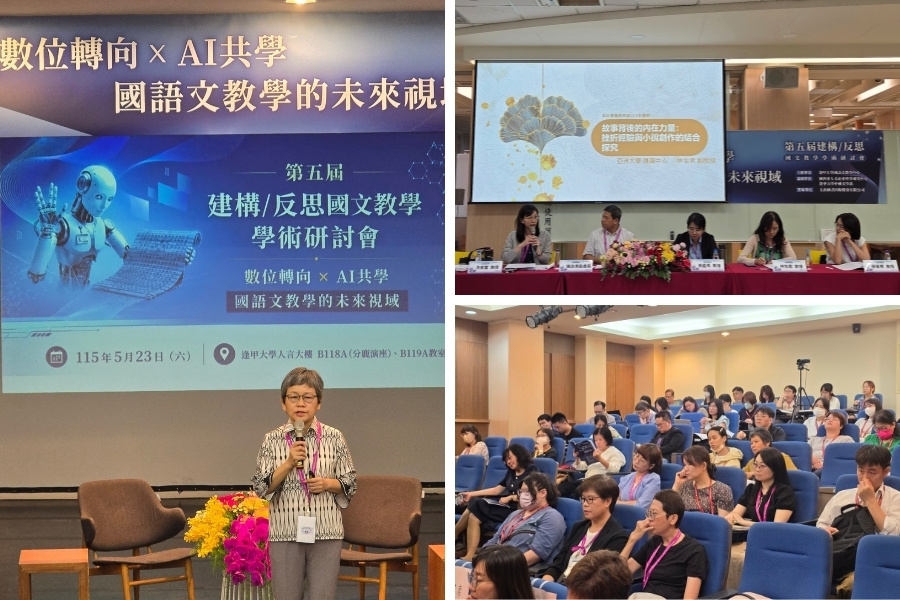
The Chinese Language Teaching Center hosted the 5th Conference on Constructing and Reflecting Chinese Language Teaching. Directed by Professor Mei-Ling Yu, the event attracted enthusiastic participation from Chinese language teachers and researchers from schools across Taiwan.
Through live demonstrations, Lien illustrated the practical potential of AI in language classrooms and argued that the core objective of language education should shift from simply teaching students how to write to cultivating the ability to evaluate information, integrate ideas, and produce responsible content. Huang approached the topic from the perspective of publishing and educational content development, presenting real-world examples that revealed both the strengths and limitations of AI in curriculum design. He also highlighted emerging concerns related to content responsibility, copyright, licensing, and ethical judgment.
Both speakers agreed that the key challenge facing language education in the AI era lies in redesigning learning tasks and assessment mechanisms. Concluding his remarks, Lien offered a memorable reflection: “Let the classics be the boat and AI the oar.” The statement encapsulated both his personal journey from the humanities into the technology sector and the conference’s broader exploration of how language education can redefine its purpose in an AI-driven world.
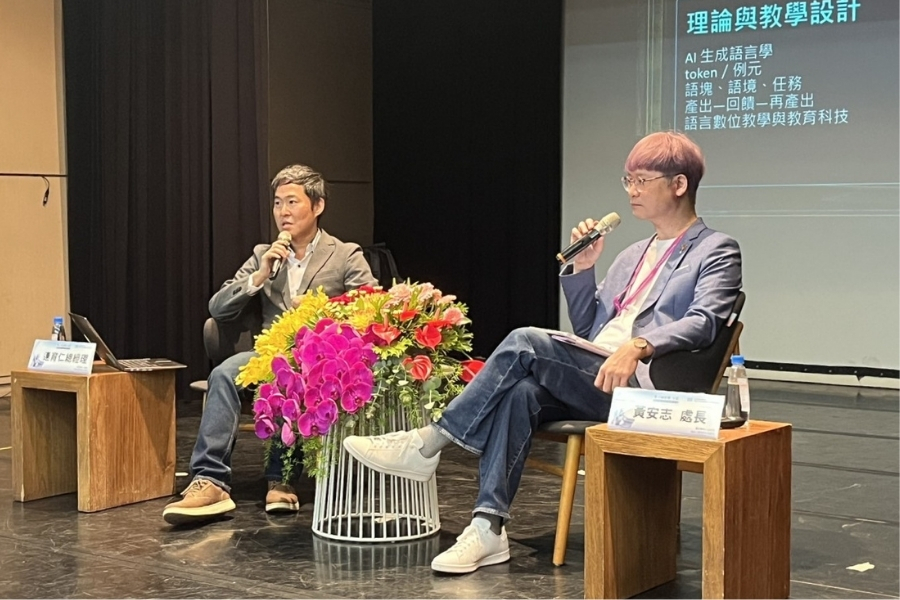
Yu-Jen Lien, General Manager of ViewSonic Taiwan, and An-Chih Huang, Director of Public Relations and New Media at Nani Education Group, delivered a joint keynote presentation titled “When AI Meets Literature and the Classics.”
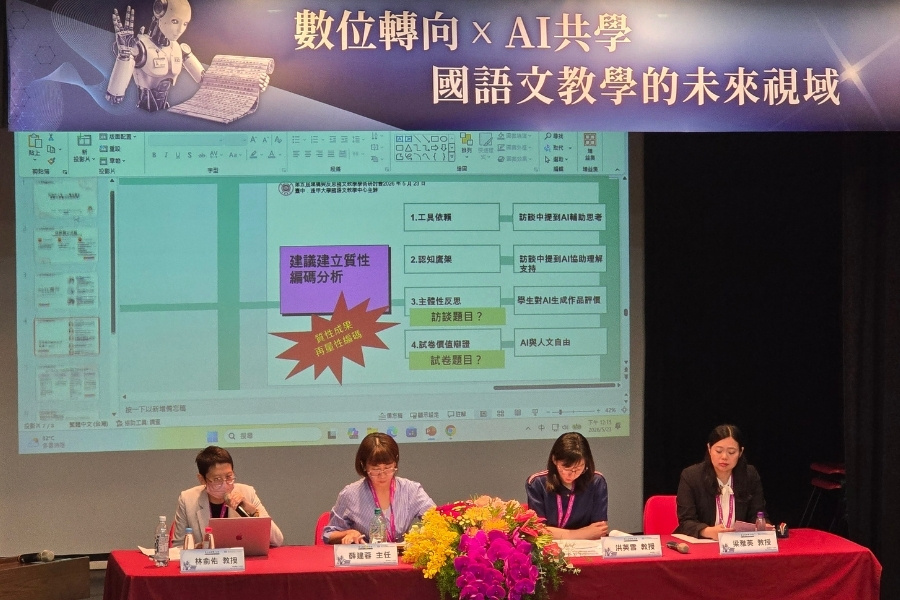
The opening session of the 5th Conference on Constructing and Reflecting Chinese Language Teaching was held at the Fenlu Lecture Hall.
The conference featured 13 academic paper presentations covering topics such as AI-assisted writing instruction, digital subjectivity, digital learning tools, curriculum innovation, cross-media creation, online exhibition-based teaching, distance learning for modern poetry, creative approaches to classical literature instruction, issue-based learning, and oral history projects.
Session chairs included Chien-Jung Hsueh of Fooyin University, Cheng-Yen Chen of National Chiayi University, Hui-Ling Wang of Feng Chia University, and Ching-Wen Lo of National Sun Yat-sen University. Presenters and commentators represented a broad range of institutions, fostering meaningful interdisciplinary dialogue and inter-university collaboration. Many of the participants belong to a new generation of scholars actively engaged in both academic research and the digital transformation of teaching practice.
In the closing session, Professor Yu returned the discussion to the fundamental mission of Chinese language education. While acknowledging the importance of scientific reasoning, analytical thinking, technical development, and evidence-based inquiry in the AI era, she argued that education must extend beyond what can be calculated, generated, and quantified.
She emphasized that Chinese language education must continue to safeguard what she termed “poetic truth.” Through literature, language, and lived experience, students learn to confront complexity, embrace contradictions, discern values, and maintain intellectual honesty amid an overwhelming flow of information.
As AI tools proliferate and answers become increasingly accessible, the mission of university Chinese language education is not to compete with AI in speed but to help students preserve an inner compass—one grounded in deep reading, independent judgment, ethical responsibility, and integrity in communication and writing.
Professor Yu concluded by observing that, although the conference themes have evolved over the years—from teaching practice and the classical-versus-vernacular debate to internationalization, digital transformation, and AI co-learning—the core commitment to meaningful and human-centered education has remained unchanged.
撰稿|逢甲大學國語文教學中心助理教授 周盈秀
Share:
Related News