


Share:
As part of its Professional Knowledge Popularization Narrative Series, the Chinese Language Education Center at Feng Chia University organized a special lecture under the theme “Narratives of Art and Culture.” Following the university-wide “Knowledge Gems: AI-Enhanced Storytelling Competition,” the Center invited Fang-Ling Tseng, Director of the Exhibition Department at the Kaohsiung Museum of Fine Arts (KMFA), to deliver a lecture titled “Palace Paradis: Curating Taiwan’s Paper Offering Culture at the Musée du Quai Branly in France.” The event was held on April 28 and introduced students to the world of museum management and international curatorial practice.
Transforming Cities Through Art and Culture
Director Tseng began by exploring how museums can transform cities. Citing examples such as the Centre Pompidou in Paris, the Guggenheim Museum Bilbao in Spain, and the 21st Century Museum of Contemporary Art, Kanazawa in Japan, she explained that museums are far more than buildings that house collections. They can become catalysts for urban renewal, tourism development, and cultural identity formation.
Drawing on Kaohsiung’s own experience, she noted that the area surrounding the Kaohsiung Museum of Fine Arts was largely undeveloped three decades ago but has since become a vibrant cultural district. This transformation reflects not only changes in the physical landscape but also the reshaping of the city’s identity. Cities, she emphasized, are ultimately formed by people, memories, conflicts, and cultures rather than by architecture alone.
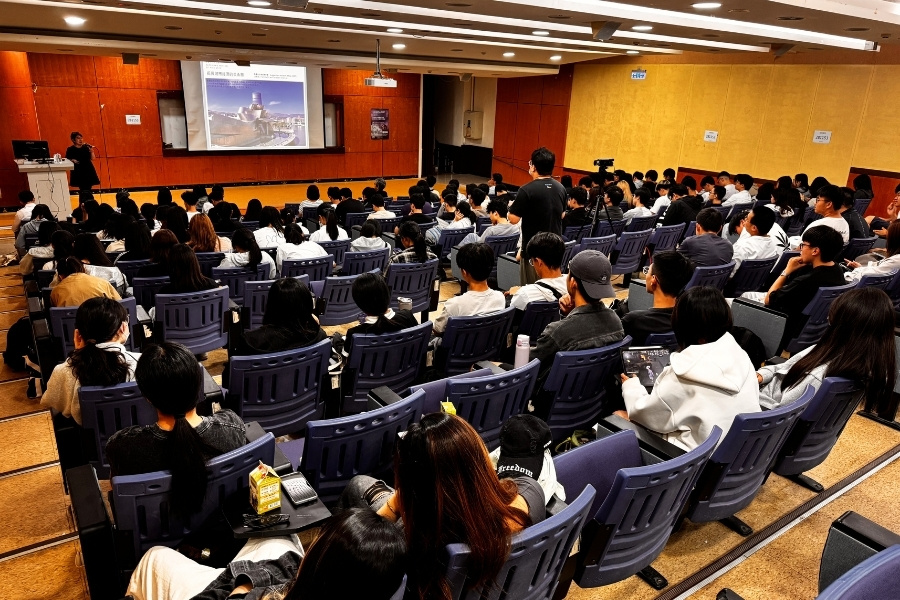
Fang-Ling Tseng, Director of the Exhibition Department at the Kaohsiung Museum of Fine Arts, visited Feng Chia University to deliver a lecture titled “Palace Paradis: Curating Taiwan’s Paper Offering Culture at the Musée du Quai Branly in France,” sharing her experience in international exhibition planning and cultural storytelling.
From Japanese Flags to the ROC Flag: The Historical Narrative of Offering Horses
Director Tseng described museums as windows that reveal not only the world but also the passage of time. She emphasized that international collaboration should not simply focus on importing famous exhibitions but also on finding ways for Taiwan to tell its own stories.
As an example, she discussed Lin Yu-Shan’s painting Offering Horses (Horse Presentation), a folding-screen work in mineral pigments completed in 1943 and later modified in 1947 and restored again in 1999. The evolution of the painting reflects Taiwan’s complex political history.
Created during the Japanese colonial era, the painting originally depicted Japanese flags, reflecting wartime mobilization efforts in Taiwan. After Japan’s defeat and Taiwan’s transition to Nationalist rule, Lin altered the flags to those of the Republic of China. Decades later, while restoring the damaged work, he reinstated the original Japanese flags before donating the painting to the Kaohsiung Museum of Fine Arts. Director Tseng explained that the painting’s history serves as a microcosm of Taiwan’s modern history and demonstrates how artworks can embody multiple layers of historical memory.
Bringing Taiwan’s Paper Offerings to France
One of the KMFA’s most notable international projects was “PALACE PARADIS: Taiwan’s Paper Offering Culture,” presented at the Musée du Quai Branly–Jacques Chirac in Paris in 2019.
The exhibition was jointly organized by the Taiwan Cultural Center in France, the Musée du Quai Branly, and the Kaohsiung Museum of Fine Arts. It introduced international audiences to Taiwan’s traditional and contemporary paper-offering craftsmanship.
Director Tseng explained that paper offerings are distinctive because they are created to be burned as part of ritual practices, symbolizing love, memory, and continuing bonds between the living and the deceased. Because these works are often destroyed through ritual use, many remarkable examples of craftsmanship remain unseen and undocumented. Curatorial practice therefore plays a vital role in preserving and reinterpreting these cultural traditions.
The exhibition presented both traditional and contemporary works. Traditional creations included spirit houses, ceremonial figures, and ritual objects used in ancestor worship and Ghost Festival ceremonies. Contemporary works featured miniature luxury goods, sports cars, smartphones, French pastries, and tea houses, demonstrating how paper-offering culture continues to evolve alongside modern consumer life.
Director Tseng recalled that French curators were surprised by the vibrant colors of the exhibits and questioned why funerary objects were not dark or somber. Taiwanese artisans explained that the purpose of paper offerings is not to imagine a gloomy afterlife but rather to envision loved ones enjoying a fulfilling and comfortable existence in another world. Through this perspective, paper offerings become narratives about love, remembrance, and continuity rather than symbols of mourning alone.
Creating New Audiences for Museums
Director Tseng also reflected on the unpredictability of exhibition success. While the KMFA’s collaboration with the Musée du Quai Branly on PALACE PARADIS attracted widespread attention, another exhibition, “TATTOO: Marks of Identity,” proved highly successful in Canada and the United States but received a more modest response in Taiwan.
When asked what makes an exhibition popular, she humorously admitted that there is no formula. Instead, she encouraged students to remain curious, observe everyday life closely, and draw inspiration from their surroundings.
She stressed that museums should not simply wait for audiences who already appreciate art; they must actively cultivate new audiences. The KMFA has done so through music events, guided tours, educational programs for schoolchildren, ecological activities, and community markets that make museums more accessible and welcoming.
Perhaps the most meaningful example was an accessible tactile exhibition designed for visitors with visual impairments. The exhibition incorporated Braille descriptions, tactile guides, guided interpretation, and access for guide dogs, allowing visitors to experience artworks through touch. By feeling textures, forms, and structures, participants could build their own understanding of artistic expression.
These efforts, she explained, go beyond accessibility measures. They challenge conventional assumptions about who has the right to experience art and reaffirm the museum’s role as a truly public space.
Through Director Tseng’s presentation, students gained a deeper appreciation of how museums preserve culture, foster dialogue, and connect people across time and place. They also learned that, much like language itself, art offers a powerful way to understand, interpret, and engage with the world.
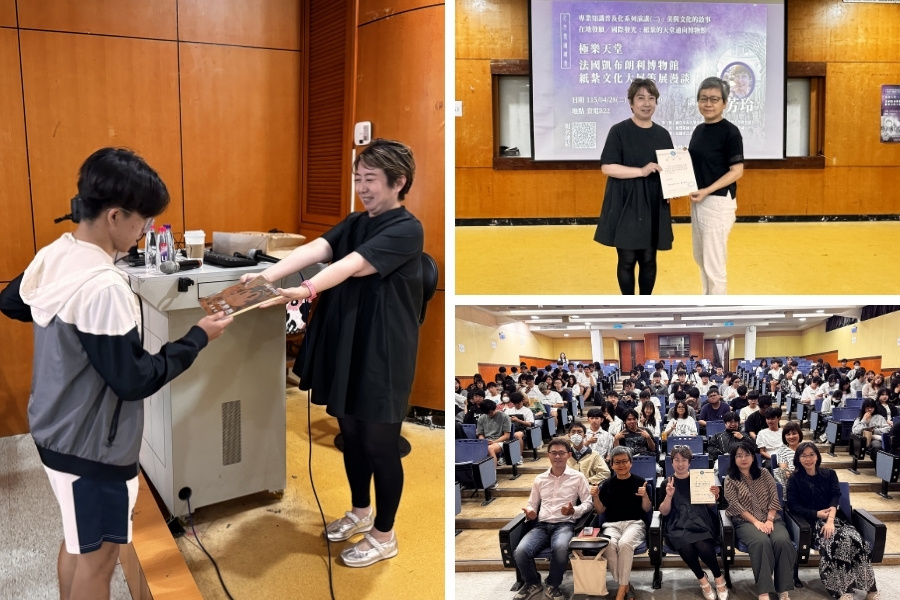
Following the lecture, Director Tseng presented small gifts to students who participated in the discussion. Mei-Ling Yu, Director of the Chinese Language Education Center, also presented a certificate of appreciation on behalf of the University to express sincere gratitude for her insightful presentation.
撰稿|人文社會學院國語文教學中心專任助理教授徐培晃
Share:
Related News