


Share:
To broaden students’ international perspectives and deepen their understanding of Islamic culture, the Center for General Education held a lecture titled “The Middle East Beyond the Headlines: Unveiling the Hidden Connections Between the Arab World and Taiwan” on October 1. The event featured Deng Sheng-Ping, former Representative to Saudi Arabia from 2017 to 2024 and currently Minister at the Secretariat Office of the Ministry of Foreign Affairs, who shared his firsthand experiences and insights into the region.
Drawing on familiar experiences such as the Mediterranean diet, shawarma, Muslim migrant workers in Taiwan, and the frequent transit routes Taiwanese travelers take through Dubai and Abu Dhabi when visiting Europe, Minister Deng illustrated how Taiwan has already developed close and lasting connections with the Islamic world.
During the lecture, Deng introduced the shared historical roots of Judaism, Christianity, and Islam, as well as the rise and development of Islamic civilization. He emphasized that the Middle East should not be understood solely through the lens of war and conflict, but rather through its rich history, culture, and civilizational achievements.
He also discussed Saudi Arabia’s ongoing national transformation under Crown Prince Mohammed bin Salman (MBS). In recent years, the kingdom has actively invested in emerging industries, including artificial intelligence, information technology, and data centers, as part of its strategy to diversify the economy and reduce dependence on oil revenues.
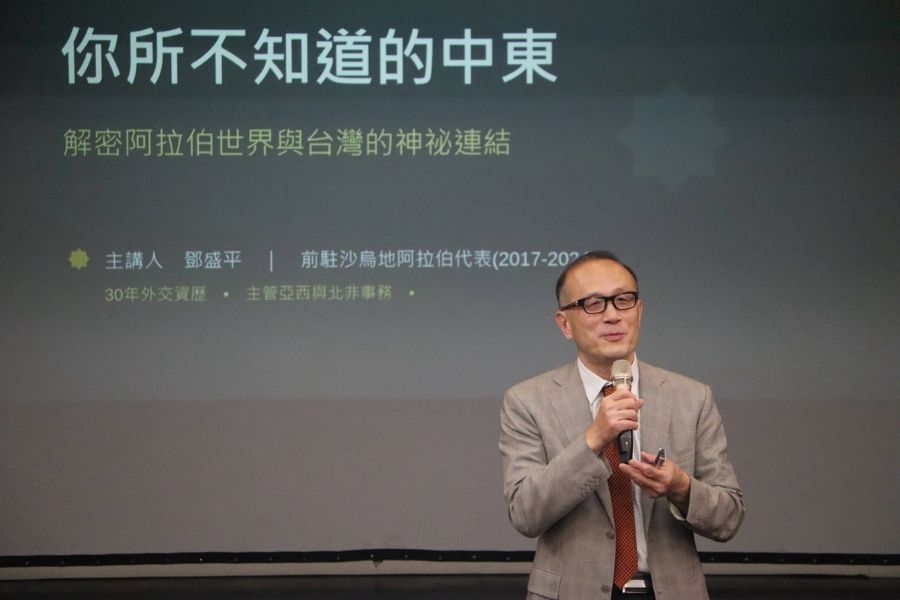
Deng Sheng-Ping, Minister at the Secretariat Office of the Ministry of Foreign Affairs, delivered a lecture titled “The Middle East Beyond the Headlines: Unveiling the Hidden Connections Between the Arab World and Taiwan” at Feng Chia University on October 1.
In the areas of tourism and social development, Saudi Arabia has introduced an electronic tourist visa program in recent years, significantly lowering application requirements and costs. These measures have gradually opened what was once considered a relatively closed country to the international community. At the same time, the kingdom has actively developed cultural destinations such as AlUla and increased its global visibility through international sporting events, the esports industry, and large-scale infrastructure projects.
Saudi Arabia has also pursued a series of social reforms since 2018, including legalizing women’s right to drive, easing gender segregation in public spaces, and reopening cinemas. These initiatives have helped create a social environment more aligned with modernization and international engagement. Together, these reforms demonstrate the country's efforts to strike a new balance between preserving traditional culture and advancing national development.
Minister Deng also reflected on the history of cooperation between Taiwan and Saudi Arabia. In addition to the professional services provided by Taiwanese medical teams in the kingdom, the two sides have maintained close exchanges in infrastructure development and engineering technology. Notable projects that benefited from Saudi financial assistance include the Chung-Sha Bridge on Taiwan’s Sun Yat-sen Freeway crossing the Zhuoshui River and the construction of Taipei Main Station.
During the Q&A session, students enthusiastically raised questions, reflecting their strong curiosity about Middle Eastern culture and contemporary international affairs. Drawing on his extensive diplomatic experience and professional expertise, Minister Deng provided thoughtful and accessible responses. The engaging dialogue not only challenged long-held stereotypes about the Islamic world, but also offered faculty and students a deeper understanding of the tangible connections between Taiwan and the Middle East.
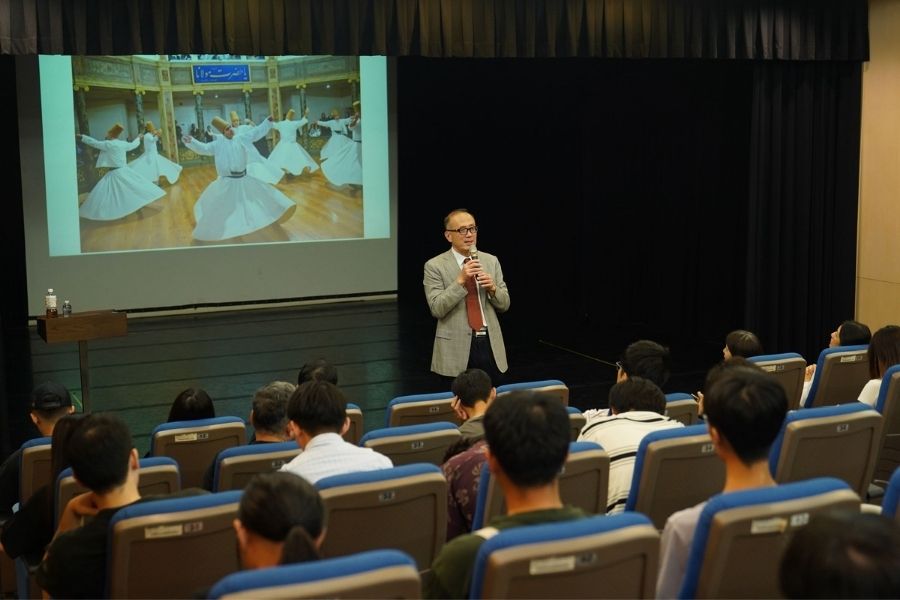
Deng Sheng-Ping guided Feng Chia University faculty and students through the real-world connections between Taiwan and the Middle East, using examples ranging from shawarma and international transit experiences to the Saudi-funded Chung-Sha Bridge, illustrating how the two regions have long been linked through culture, transportation, and infrastructure development.
Share:
Related News