


Share:
Organized by the Department of Chinese Literature at Feng Chia University, Between Journeys: Urban Stations and Railway Professionals will officially open on May 30 at the Cross Corridor on the first floor of Taichung Railway Station and run through July 12. The exhibition is the annual outcome of the department’s Graphic Editing Project course. Through extensive interviews, field research, and editorial design, students explored Taiwan’s railway culture and documented the life stories of railway professionals, inviting the public to rediscover the human spirit behind Taiwan’s railways.
Centered on the themes of urban stations and railway professionals, the exhibition features interviews with six key figures in Taiwan’s railway industry, covering railway history, train maintenance, station operations, and tourist train transformation projects. Among the highlights are two nationally recognized steam locomotive drivers, Kun-Hsiu Liu and Da-Hsiung Lu, both aged 88. Having witnessed the steam train era and decades of railway development, they will attend the opening ceremony to share their railway experiences with visitors.
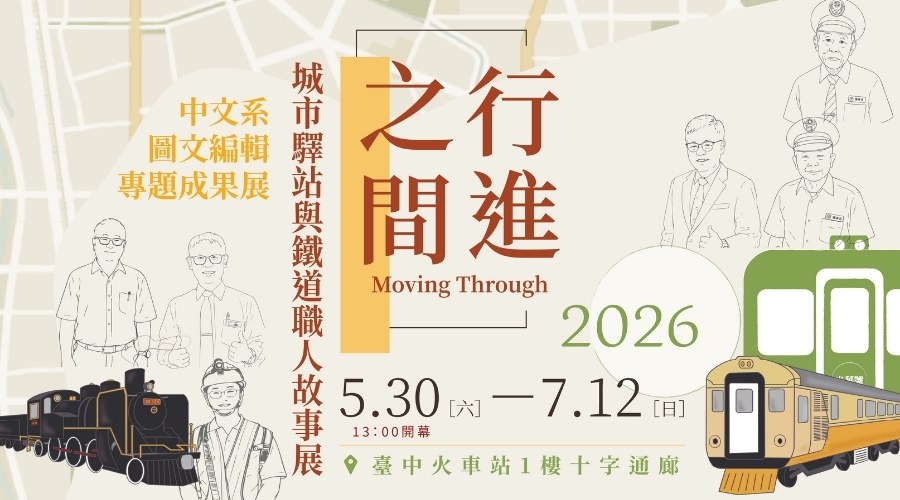
Organized by FCU’s Department of Chinese Literature, Between Journeys: Urban Stations and Railway Professionals will be on display at the Cross Corridor on the first floor of Taichung Railway Station from May 30 to July 12.
Students Document the Lives Behind Taiwan’s Railways
In addition to the veteran locomotive drivers, students interviewed professionals involved in the refurbishment of tourist trains such as Formosa Express and Sea Breeze Express, as well as former TRA Mechanical Department Director Hung-Kang Sung, Taichung Operations Section Chief Chao-Ping Lee, Taichung Station Master Ho-Chieh Wang, and electrical engineer Chia-Hsing Wu. Through in-depth interviews and on-site observation, students gained a deeper understanding of railway maintenance, operations management, scheduling, and station administration while uncovering the dedication and craftsmanship that sustain Taiwan’s railway culture.
The exhibition also incorporates a guided railway heritage tour of Taichung’s Central District, encouraging visitors to explore the historical relationship between the railway station and urban development. Through the integration of exhibition content and physical space, students present railways not merely as transportation systems, but as important carriers of urban growth, human mobility, and collective memory.
From Writing to Design: Building Interdisciplinary Skills
Project advisor Professor Feng Yu of the Department of Chinese Literature explained that the Graphic Editing course is one of the department’s key project-based courses. Students develop skills in writing, editing, interviewing, photography, visual design, and layout production using professional software such as Adobe Illustrator and Adobe InDesign. Each team is required to produce a 24–32-page magazine, following a workflow similar to that of the publishing industry.
This year, 17 student teams participated in the exhibition project, each independently planning and editing its own theme. The experience not only brings students into direct contact with industry and culture but also strengthens teamwork, communication, and problem-solving abilities. Public exhibition further challenges students to present their work to broader audiences and engage directly with visitors, providing valuable preparation for future careers.
Industry–Academia Collaboration Expands New Possibilities for Chinese Literature
Between Journeys: Urban Stations and Railway Professionals demonstrates the Department of Chinese Literature’s commitment to industry–academia collaboration and interdisciplinary learning. Contemporary Chinese literature education extends beyond traditional literary studies to embrace interviewing, editorial planning, digital design, cultural marketing, and public communication.
The exhibition also received support from Wendy Lin, Deputy General Manager of Classics International, her team, the Ministry of Education’s iLink Project, Taiwan International, and the Old Town Green House Story Museum. Their contributions enabled students to engage directly with Taiwan’s railway industry and local cultural communities, helping bring these valuable railway stories to a wider audience.
Share:
Related News