


Share:
To help faculty members and students stay ahead of emerging technology trends, the College of Information and Electrical Engineering at Feng Chia University and the Motech Smart City 5G Laboratory jointly hosted a special lecture titled “6G and AI: Why? What? and How?” on May 5, with support from the University’s 5G Faculty Professional Development Community. The event featured Li-Chun Wang, Dean of the College of Electrical and Computer Engineering at National Yang Ming Chiao Tung University (NYCU), as the keynote speaker.
Dean Wang is an IEEE Fellow and a leading expert in wireless communications and artificial intelligence. With extensive experience in both academic research and industry collaboration, he is widely recognized for his contributions to next-generation communication technologies.
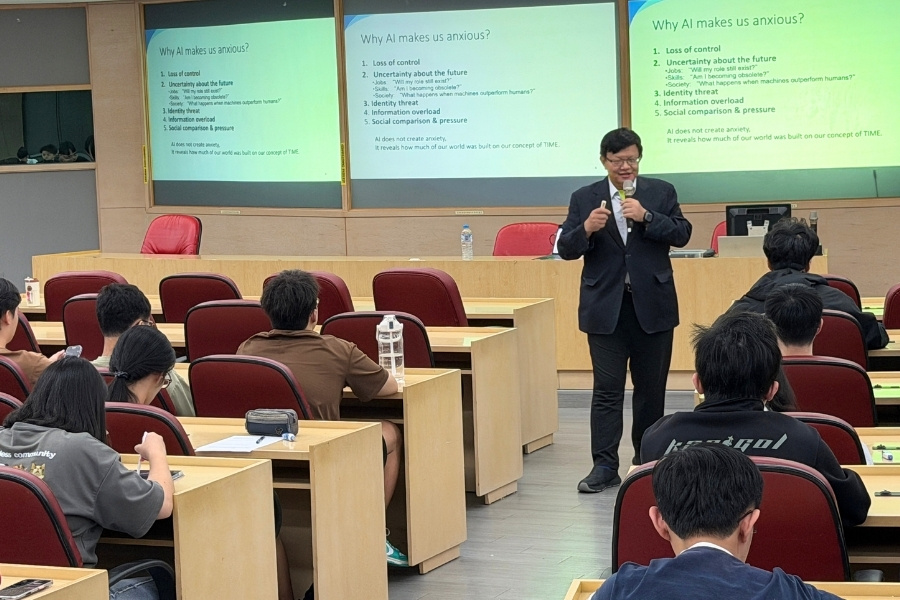
Li-Chun Wang, Dean of the College of Electrical and Computer Engineering at National Yang Ming Chiao Tung University, delivered a keynote lecture titled “6G and AI: Why? What? and How?”.
The lecture focused on the convergence of 6G communications and artificial intelligence, examining how future communication networks will support the rapid expansion of AI applications. Dean Wang emphasized that AI and 6G are evolving in a highly interdependent manner and will jointly drive technological innovation in the coming decades.
He explained that AI is moving beyond isolated devices and cloud-based computing toward distributed architectures and real-time decision-making systems. Future applications will include autonomous vehicles, unmanned aerial vehicles (UAVs), smart cities, and robotics, making 6G communications a critical infrastructure for large-scale AI deployment.
From a technical perspective, Dean Wang noted that 6G will provide ultra-high-speed transmission, ultra-low latency, and massive connectivity, overcoming many of the data transmission and computing limitations currently faced by AI systems. He also introduced the concept of Integrated Sensing and Communication (ISAC), which will enable communication networks to simultaneously support environmental sensing and intelligent decision-making.
In addition, he highlighted the emergence of Agentic AI and Physical AI, describing how future AI systems will not only generate content but also proactively perform tasks and interact directly with the physical world.
Beyond technological developments, Dean Wang also addressed the importance of talent cultivation in the AI era. He stressed that the key challenge is not whether people will be replaced by AI, but rather how they can effectively leverage AI while continuously strengthening their own expertise.
Drawing on the concept of “circular time,” he encouraged students to focus on developing their core competencies and professional strengths. Rather than becoming passive users of technology, students should position themselves as individuals who can strategically integrate and direct AI tools to solve complex problems.
The lecture attracted nearly 170 faculty members and students from the fields of communications engineering, electrical engineering, electronic engineering, information engineering, automatic control engineering, and artificial intelligence. Audience participation was enthusiastic, with lively discussions throughout the event.
Feng Chia University stated that it will continue strengthening its foundation in 5G/6G research and talent development through advanced technology education, industry-academia collaboration, and interdisciplinary partnerships. By doing so, the University aims to prepare students for the next generation of communication technologies and enhance their global competitiveness.
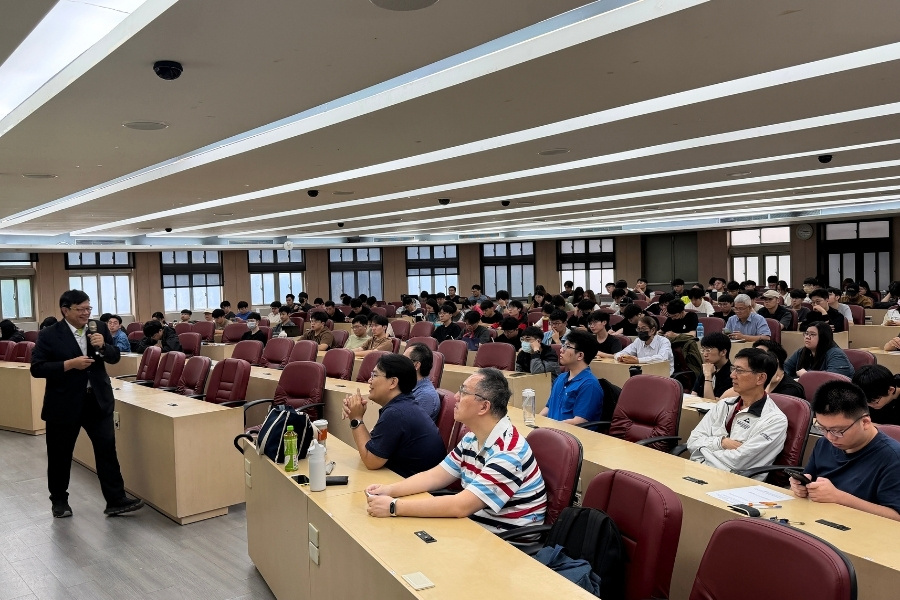
Focusing on the future integration of 6G and AI, the lecture attracted nearly 170 faculty members and students from related disciplines.
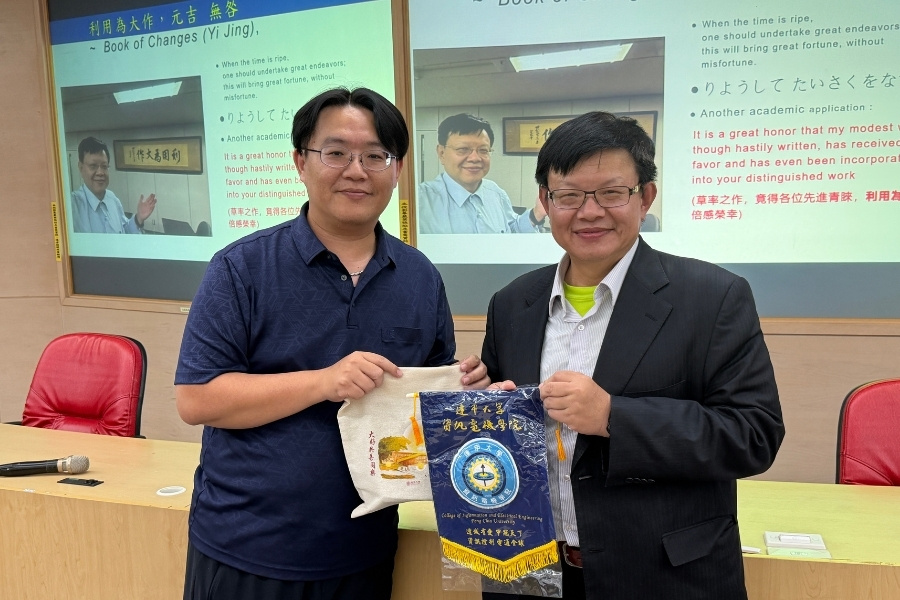
Yuan-Yu Tsai, Chair of the Department of Communications Engineering, presented a commemorative plaque to Dean Li-Chun Wang (right) in appreciation of his visit and insightful presentation.
Share:
Related News