


Share:
Breaking the traditional stereotype of Chinese Literature majors, the Department of Chinese Literature at Feng Chia University has successfully integrated humanities education with digital technology, showcasing impressive interdisciplinary achievements. At the recently concluded 2026 Microsoft Office Specialist (MOS) National Championship, FCU students delivered outstanding performances. Among them, senior student Jo-Chu Chiang advanced to the national top four and earned the opportunity to represent Taiwan at the MOS World Championship to be held at Disneyland Resort in California, USA.
In recent years, the Department of Chinese Literature has actively promoted the integration of digital technology and humanities education, emphasizing that students should possess not only strong writing, planning, and cultural literacy skills but also proficiency in AI applications and digital tools. In addition to offering eight credits of AI-related foundational courses, the department incorporates international certifications such as ACP and MOS into courses on graphic editing, publication design, and project-based learning. Through project-oriented instruction, students develop practical competencies and interdisciplinary integration skills. As a result, nine students from the department qualified for the national finals of the 2026 ACP/MOS Competition, demonstrating the department’s success in cultivating cross-disciplinary talent.
At the MOS National Championship held on May 23, sophomore Tong-Yun Wang and senior Jo-Chu Chiang excelled in the Microsoft MOS Word Expert Division. Chiang ultimately advanced to the national top four and secured a place on Taiwan’s representative team for the MOS World Championship in California. This achievement reflects not only her personal dedication but also the department’s long-term commitment to technology education and practical skills development.
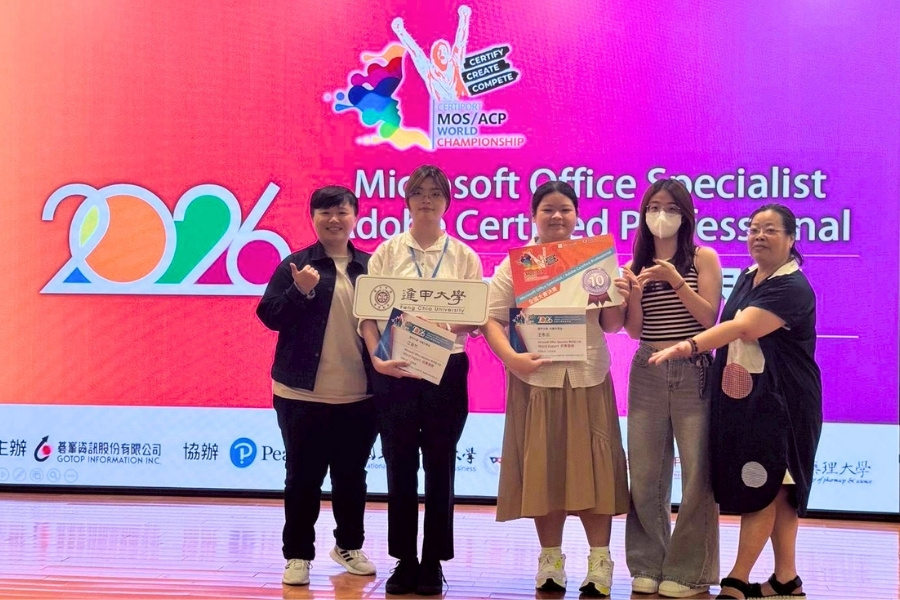
Jo-Chu Chiang, a student from FCU’s Department of Chinese Literature, won fourth place in the MOS National Championship and earned the opportunity to represent Taiwan at the MOS World Championship, which will be held at Disneyland Resort in California on July 26.
According to Jo-Chu Chiang, the MOS competition is no longer simply a test of software proficiency. While the preliminary round focuses on technical skills, the national finals place greater emphasis on real-world application and integrated problem-solving abilities. In the MOS Word category, this year’s competition centered on designing a comprehensive project proposal, requiring contestants to demonstrate not only advanced Word functions but also planning, organization, and content integration skills. Chiang attributed her success to the extensive project planning and proposal-writing experience she gained through coursework in the Department of Chinese Literature, which enabled her to quickly understand competition requirements and complete the challenge effectively.
Faculty advisor Professor Feng Yu further noted that some students had just begun their competition training, while others had developed their abilities gradually through coursework and the Ministry of Education’s iLink Program. Student growth, he emphasized, is the result of diverse learning opportunities and practical experiences rather than any single course. Many students have also served as assistants on project teams, where they learned teamwork, communication, and problem-solving skills—competencies that proved invaluable during the competition.
The department’s continued success in national competitions demonstrates the effectiveness of its educational approach, which combines professional expertise with digital capabilities. As AI and digital transformation reshape the workplace, career opportunities for Chinese Literature graduates have expanded far beyond traditional publishing. Today, graduates are entering fields such as project planning, project management, technology integration, digital content design, and e-commerce. The success of alumni working in these industries further illustrates how the integration of humanities and technology is gaining recognition from both industry and society.
Share:
Related News