


Share:
In an era when AI can answer almost any question instantly, the value of knowledge is shifting from how much one possesses to whether it can be discovered and understood by others. On March 23, the Chinese Language Teaching Center at Feng Chia University hosted the first lecture in its “Little Knowledge, Big Gems: AI-Powered Video Storytelling Competition for Popularizing Academic Expertise” series. The featured speaker was Kuo-Wei Cheng, co-founder of PanSci, Taiwan’s largest science media platform, who shared insights into how knowledge communication is evolving in the age of digital media, data analytics, and AI.
The event attracted more than 200 faculty members and students. Shu-Yuan Chou, Chair of the Taipei Feng Chia University Alumni Education Foundation, and Executive Director Chun-Tang Chou also returned from Taipei to support the event.
The lecture opened with Professor Pei-Huang Hsu introducing the competition, encouraging students to translate specialized knowledge into engaging three-minute videos that are accessible, relatable, and technology-oriented. Kuo-Wei Cheng then delivered a presentation titled “The Knowledge Knowledge Creators Need,” sharing both the successes and setbacks of PanSci’s entrepreneurial journey and offering practical insights into content creation, data analysis, and storytelling.
Liberal Arts Students Can Do Science Communication Too
At the beginning of his presentation, Cheng surprised many attendees by revealing that he was not trained in science. Instead, he studied foreign languages and communications, identifying himself as a liberal arts graduate.
According to Cheng, AI has largely dismantled traditional boundaries between disciplines. As access to specialized knowledge becomes increasingly democratized through AI tools, the real differentiator is no longer one’s ability to obtain information, but rather the ability to explain complex ideas clearly and keep audiences engaged.
He argued that the most important skill of the future is not simply knowing the answers, but possessing the ability to translate knowledge—transforming complicated concepts into narratives that are understandable, engaging, and shareable.
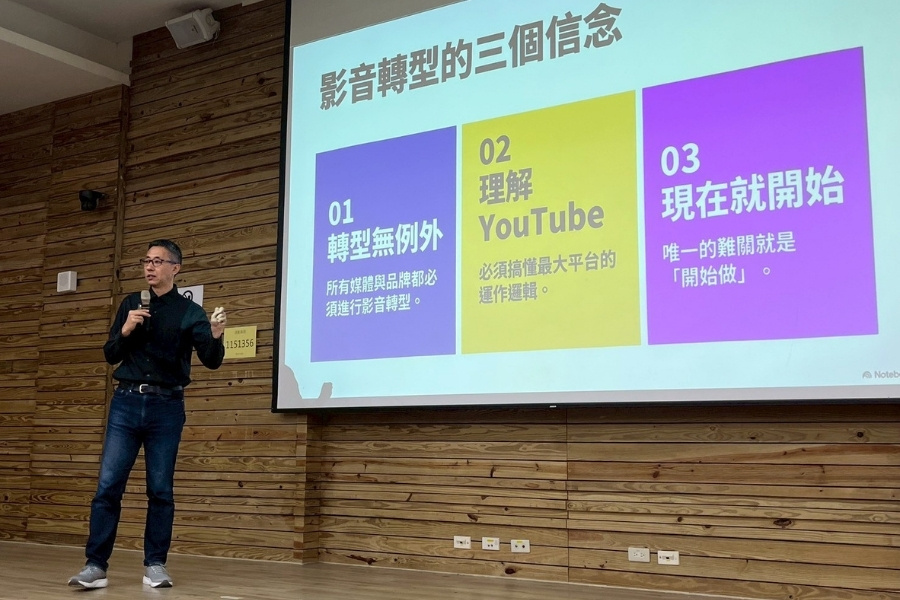
Kuo-Wei Cheng, co-founder of Taiwan’s largest science media platform PanSci, shared three core beliefs behind PanSci’s successful transformation from text-based content to video media with faculty and students at Feng Chia University.
Learning from Setbacks: From Blogging to Video Transformation
Reflecting on PanSci’s development, Cheng acknowledged that the road to success was far from smooth. Founded in 2011, PanSci initially benefited from the rapid growth of social media platforms and experienced significant traffic growth. However, as algorithms evolved and video content became dominant, text-based content gradually lost its competitive advantage.
A turning point came in 2022 when a gathering of content creators convinced him of the growing influence and vitality of video media. As a result, PanSci made the bold decision to stop updating its website and focus entirely on YouTube. Today, PanSci has grown into a channel with over one million subscribers and has successfully launched several related content brands.
Viral Success Is Data-Driven, Not Luck
Cheng emphasized that successful content creation cannot rely on chance; data must serve as a strategic compass. He introduced several key performance indicators that guided PanSci’s growth:
- Impressions – determining whether content is being discovered.
- Click-Through Rate (CTR) – highlighting the importance of compelling titles and thumbnails that create contrast, curiosity, and intrigue.
- First 30-Second Retention Rate – what Cheng described as “the algorithm’s life-or-death judgment,” making a strong opening hook essential.
- Average View Duration – reflecting audience engagement and content quality. PanSci even developed a “Slow Science” series designed to encourage longer viewing times.
- Audience Demographics and New Viewer Ratio – helping creators balance audience expansion with retaining loyal followers.
- Shorts Retention Rate – where the first three seconds often determine success or failure.
He also noted that device type, membership growth, and geographic location are important metrics for creators seeking sustainable channel growth.
Three Seconds Decide Everything
Discussing the rise of short-form video, Cheng stressed that short videos are no longer merely promotional tools for longer content but have become a separate ecosystem entirely.
To compress extensive scientific information into a brief format while maintaining accuracy, PanSci developed a unique short-video style characterized by rapid pacing and curiosity-driven language. During the lecture, Cheng humorously analyzed his own techniques, pointing to frequently used phrases such as “This just got awkward,” “Unexpectedly,” and “Believe it or not.” Students immediately recognized the examples and responded enthusiastically, generating laughter throughout the auditorium.
He explained that these techniques continuously stimulate audience curiosity, lowering the psychological barriers to engagement and ultimately helping convert casual viewers into long-term followers.
The Best Time to Start Is Now
“The best time to plant a tree was ten years ago. The second-best time is now.”
Using this well-known saying, Cheng encouraged students to begin building their personal brands and transforming their knowledge as early as possible. While data may not provide a magical formula for success, it offers valuable clues for informed decision-making.
In Cheng’s view, the most critical competency in the AI era is not knowledge itself, but meta-knowledge—knowing how to learn, adapt, and continuously acquire new skills.
The Q&A session was equally engaging. One student creator, whose content had accumulated more than five million views, asked how explosive public-platform traffic from channels such as Threads could be converted into long-term followers and members. Cheng recommended first establishing a strong content home base on platforms such as YouTube or Instagram, then deepening audience relationships through communities and newsletters to maintain stability despite algorithm changes.
After the Lecture: Could You Be the Next Person to Be Seen?
Even after the lecture concluded, many students remained to continue discussions and exchange ideas. The event was more than a sharing session—it served as a spark of inspiration, encouraging participants to move beyond simply understanding knowledge toward making it visible and meaningful for others.
For many students, the lecture opened a new perspective: in the AI era, success may depend not only on what you know, but on how effectively you can communicate your expertise to the world.
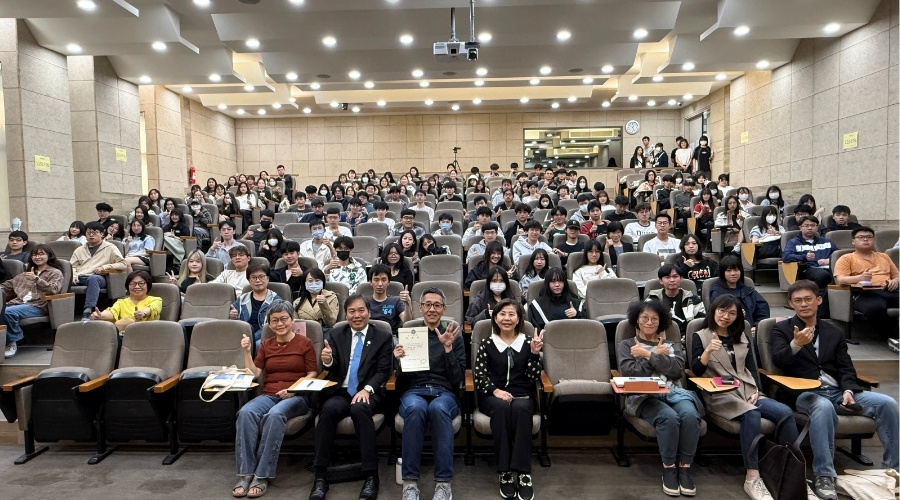
The “Little Knowledge, Big Gems: AI-Powered Video Storytelling Competition for Popularizing Academic Expertise” lecture series received an enthusiastic response, attracting more than 200 faculty members and students to the Ninth International Conference Hall.
撰稿|人文社會學院國語文教學中心專任助理教授洪英雪
Share:
Related News