


Share:
The National Science and Technology Council (NSTC) recently announced the results of its 2026 Research to Startup program, selecting 11 projects nationwide. Among them was the "Mobile Dual-Chamber Biogas Module for Small and Medium-Sized Livestock Farms" project, led by Feng Chia University Distinguished Professor and Chief Sustainability Officer Chen-Yeon Chu — the only private university team on the list. The other selected institutions were Chang Gung Memorial Hospital, National Taiwan University, National Tsing Hua University, National Chengchi University, National Sun Yat-sen University, National Cheng Kung University, and National Yang Ming Chiao Tung University.
The technology targets one of Taiwan's most common and persistent challenges: wastewater management at small and medium-sized pig farms. According to Ministry of Agriculture statistics, Taiwan has approximately 5,414 pig farms, producing more than 1 million metric tons of manure annually — equivalent to roughly 77 million cubic meters of natural gas. Yet most farms raising between 1,000 and 5,000 pigs still rely on conventional three-stage wastewater treatment, facing high costs for outsourced sludge disposal (about NT$7,000 per metric ton) and hydrogen sulfide concentrations in biogas that frequently exceed 5,000 ppm — far above the 150 ppm ceiling most biogas generators can tolerate. The result has been frequent generator damage that has kept many pig farmers from adopting biogas power generation.
At the heart of the technology developed by Chu's team is a redesign of the conventional anaerobic digestion process into two separate chambers: the first handles acidification and hydrolysis, the second is dedicated to methanogenesis. The design, patented in Taiwan (Patent No. I868610), improves energy recovery efficiency by 8% to 43% over conventional single-stage processes — an average gain of about 25%. The system also incorporates a proprietary strain, IGP01M, selected by the team, paired with an online-regenerable desulfurization purification unit that stabilizes hydrogen sulfide concentrations below 150 ppm and extends the adsorbent replacement cycle from two months to three, allowing generators to achieve an uptime rate of over 80%. The entire system is housed in a modular 40-foot container, with a sludge yield below 0.2 kg SS/kg COD — cutting sludge output at livestock farms by 70%.
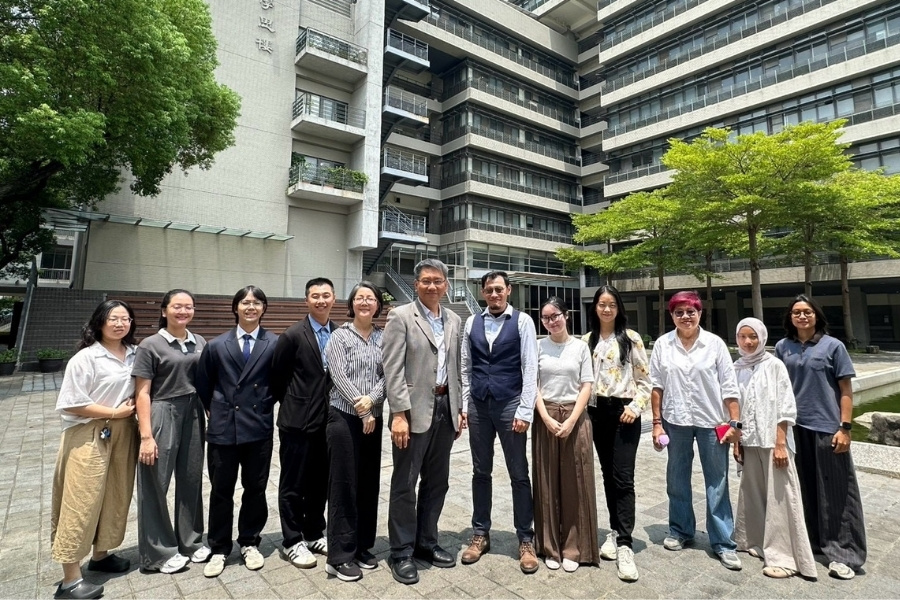
Feng Chia University Distinguished Professor Chen-Yeon Chu (sixth from left) with the research and development team.
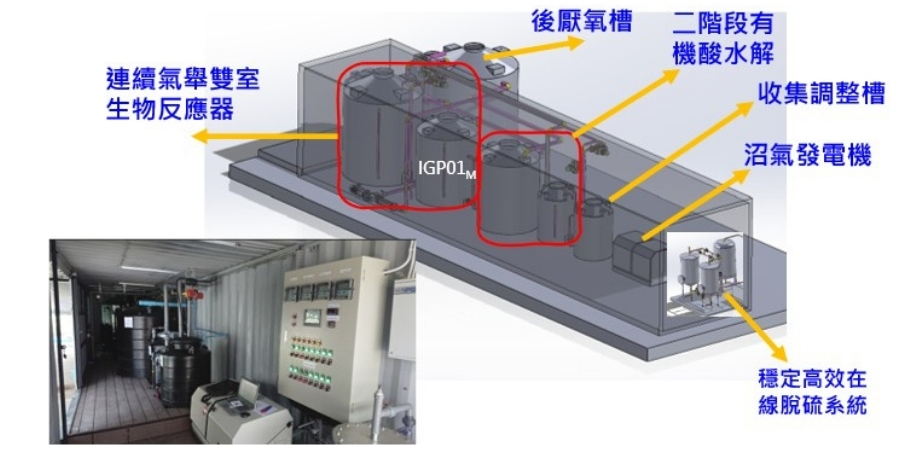
Product illustration of the mobile dual-chamber biomass biogas module.
To lower the barrier to adoption, the team uses an Energy Service Company (ESCO) model: farm owners bear no upfront cost, providing only the site and utility connections, while the team handles equipment installation, operation, maintenance, and electricity sales settlement. Farm owners then receive a 4% to 12% profit share under contract, based on actual gas production, electricity sales, and sludge reduction benefits. For a 3,000-head farm, the model is projected to generate combined annual benefits of about NT$3.48 million; factoring in sludge reduction revenue, the internal rate of return reaches 52%, with a payback period of roughly two years.
The team has partnered with Taiwan-based manufacturers including Dino Technology, Global Xin Energy, Xierui Precision Industry, Senyao Energy, and Wannianqing to achieve 100% domestic production of the equipment, with an estimated construction cost more than 30% lower than imported systems from Germany and Austria. The move is further supported by Taiwan's current biogas power feed-in tariff of NT$7.0192 per kilowatt-hour and installation incentives of up to NT$1.7 million for small and medium-sized pig farms, further lowering the threshold for commercial operation. The venture is led by Chen-Yeon Chu, with CEO Tsung-Hsien Chen — a graduate of Feng Chia University's Ph.D. Program of Mechanical and Aeronautical Engineering — heading operations. Chen was the lead planner behind the team's 2019 project to build a biogas pilot plant at Khon Kaen University in Thailand, and now brings that field experience to the new venture.
Under the team's roadmap, 2026 to 2027 will focus on field validation and intellectual property planning; 2027 to 2028 will see the company formally established with deployment at 10 sites; and 2029 to 2032 will expand to 50 domestic sites and at least one overseas site. The long-term goal is to establish 100 domestic case sites in Taiwan before exporting the equipment and technology to Southeast Asian markets including Thailand, Indonesia, Vietnam, and Malaysia. With approximately 1,348 small and medium-sized pig farms nationwide raising more than 1,000 pigs, the team estimates that capturing 50 farms — a 3.7% market share — within five years would demonstrate commercial viability, with a longer-term goal of reaching 7.4% within ten years.
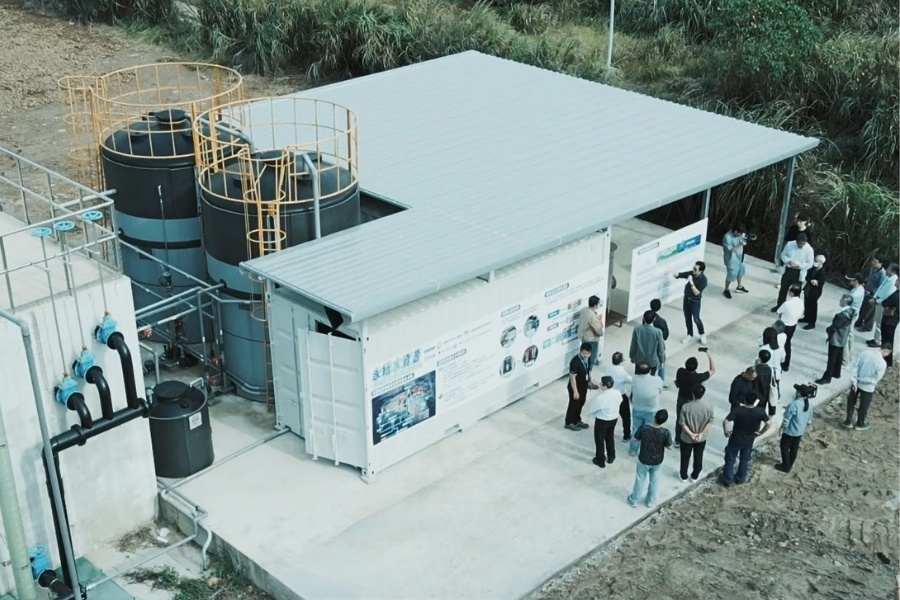
Feng Chia University has partnered with Dino Technology to advance research on household sludge reduction and fuel cell power generation.
Share:
Related News