


Share:
In response to the increasing challenges of managing cooked food waste in urban environments, and in alignment with Taiwan’s net‑zero transition and circular economy policy goals, Feng Chia University and Nikkan Development Co., Ltd. officially signed an industry–academia collaboration agreement and a doctoral excellence scholarship program on February 12. The partnership unveiled a new integrated technology for cooked food waste energy recovery, featuring three key advantages: high efficiency, low pollution, and rapid deployment.
This collaboration not only symbolizes cross‑institutional and cross‑industry resource integration, but also applies Feng Chia University’s internationally recognized, APEC‑level hydrogen energy technologies to the local transformation of urban cooked food waste into biomass energy. The solution provides local governments with a ready‑to‑deploy pathway that can be operational in as little as nine months, offering a practical and scalable approach to urban food waste energy recovery.
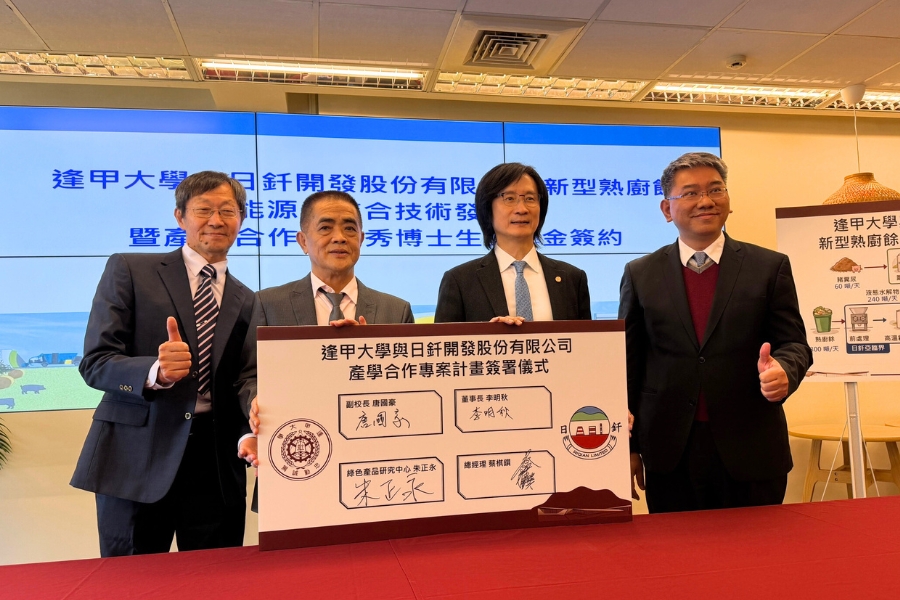
Industry–Academia Collaboration Signed to Advance Integrated Cooked Food Waste–to–Energy Technology
Vice President Kuo‑Hao Tang (second from right) of Feng Chia University, Professor Cheng‑Yung Chu (first from right), Director of the Green Products Research Center, together with Chairman Ming‑Chiu Li (second from left) and President Chi‑Chuan Tsai (first from left) of Nikkan Development Co., Ltd., signed an industry–academia collaboration agreement on the New Integrated Technology for Energy Recovery from Cooked Food Waste, while simultaneously launching an Excellence Scholarship Program for Doctoral Students.
Breaking Through Bottlenecks in Cooked Food Waste Treatment to Meet Urgent Local Government Needs
At present, most food‑waste‑to‑energy facilities in Taiwan are centered on anaerobic digestion of raw food waste for power generation. Cooked food waste, however, presents far greater challenges due to its high oil and salt content and complex composition. When directly introduced into anaerobic systems, it requires multiple additional pretreatment steps—such as slurrying, oil removal, and desalination—and often necessitates the construction of new biogas digesters. These requirements significantly extend construction timelines, raise investment costs, and increase operational and management risks, forming a long‑standing bottleneck for local governments.
The New Integrated Technology for Energy Recovery from Cooked Food Waste has been specifically designed to address these pain points, offering an integrated technical pathway that features simplified processes, shorter construction periods, lower environmental risk, and higher energy recovery efficiency.
High‑Temperature Atomized Hydrolysis Combined with Dual Energy Conversion for a Complete Circular System
The core innovation of this integrated solution lies in the introduction of a high‑temperature atomized hydrolysis system as a pretreatment technology for cooked food waste. This process effectively breaks down oils and complex organic compounds, substantially reducing the complexity and operational burden of conventional pretreatment methods.
Following hydrolysis, materials are processed through diversified pathways based on their physical characteristics.
Liquid hydrolysates are fed into Feng Chia University’s IGPM anaerobic fermentation system for hydrogen–methane biogas power generation, without the need to construct additional large‑scale digesters.
Solid hydrolysates are directed to the OTWG gasification power generation system for thermochemical energy conversion.
Compared with traditional single‑pathway cooked food waste treatment approaches, this dual energy conversion design—combining anaerobic fermentation and gasification power generation—significantly enhances overall energy recovery efficiency, distributes system load, and improves operational stability.
Transforming Organic Residuals into Green Power Feedstock to Address Energy Shortages and Agricultural Waste Pollution
The driving force behind this high‑efficiency integrated technology is Distinguished Professor Cheng‑Yung Chu of Feng Chia University’s Green Products Research Center. Professor Chu has led his team in establishing the world’s first two‑stage anaerobic bio‑hydrogen and methane power generation plant at Xinhexing Ranch in Nantou, successfully transforming agricultural and livestock waste into high‑value “green energy.”
The Green Energy team’s impact extends well beyond Taiwan. Its biomass energy technologies have been successfully transferred to Indonesia, Thailand, and other countries. In collaboration with the Italian National Research Council (CNR), the team co‑founded the Institute of Green Products, advancing research in green energy and social innovation. The team has also partnered with Deno Technology to promote domestic sludge reduction and fuel‑cell power generation research.
Through continuous technology validation and industry–academia collaboration projects, Professor Chu is leading his team to accelerate the real‑world deployment of green technologies, injecting new momentum into Taiwan’s—and the broader region’s—transition toward a low‑carbon society.
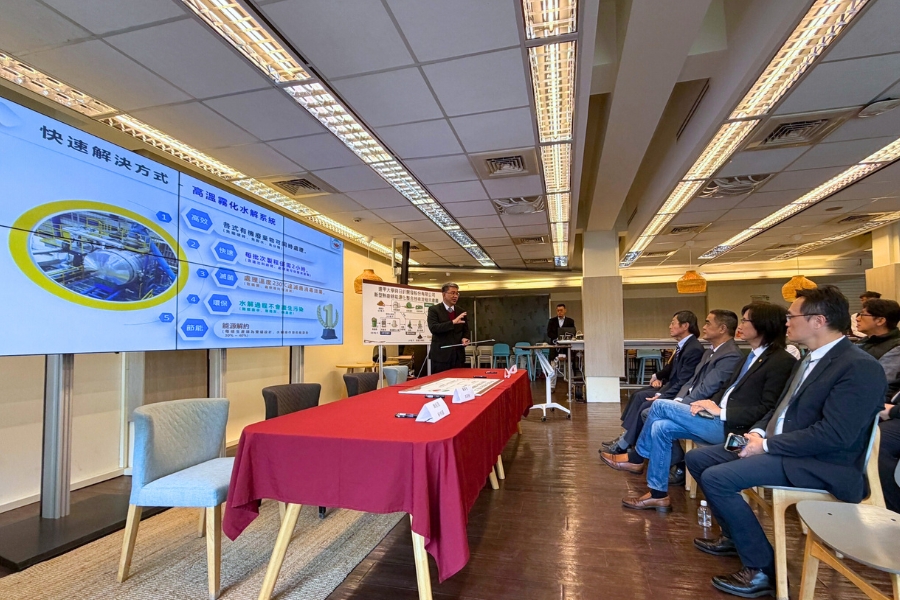
Distinguished Professor Cheng‑Yung Chu, Specially Appointed Professor at the Green Products Research Center of Feng Chia University, presents the research outcomes and application vision of the “New Integrated Technology for Energy Recovery from Cooked Food Waste.”
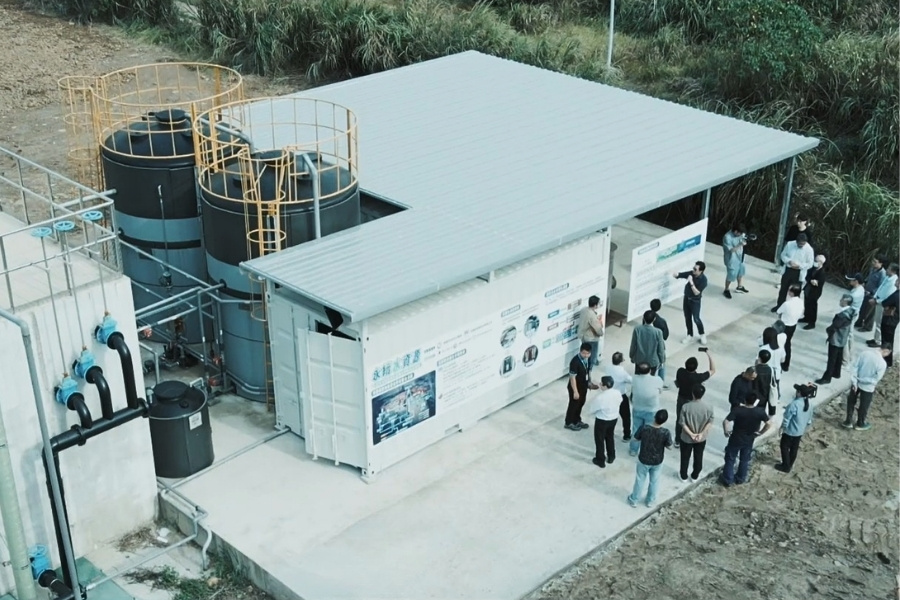
Feng Chia University and Deno Technology Advance Sludge Reduction and Fuel‑Cell Power Generation Research, Setting a New Benchmark for Sustainable Water and Green Energy Innovation
Feng Chia University is collaborating with Deno Technology to advance research on municipal sludge reduction and energy recovery through fuel‑cell power generation, establishing a new model for sustainable water resource management and green energy innovation.
Low Pollution, Low Risk: Advancing Circular Economy and Net‑Zero Goals
The IGPM anaerobic fermentation system utilizes advantageous microbial consortia for biogas power generation. Through process optimization of fermentation reactors, average biogas yields are increased. When combined with online desulfurization, purification, and regeneration technologies, the system enhances generator utilization rates. By‑products are further valorized and returned to circular agriculture, delivering an integrated solution from point to line to system‑wide deployment, thereby increasing overall economic value.
From an environmental perspective, the OTWG gasification power generation system offers key advantages, including near‑zero tar and wastewater generation and no dioxin emissions. As a result, the overall system requires little to no additional high‑cost pollution control equipment. The gasification residue is biochar, which can be recovered for agricultural use or soil improvement, further realizing carbon cycling and high‑value resource utilization—a comprehensive embodiment of circular economy principles.
In addition, the solution can be deployed at existing sites such as the Taichung Waipu Green Energy Eco‑Park, with trial operation and commercial rollout achievable within approximately nine months. Compared with traditional biogas facilities—often requiring several years to construct—this approach offers significant advantages in timeline and policy implementation efficiency.
Building a Replicable Model to Offer New Options for Policy and Industry
Both parties to the agreement expressed their shared expectation that this collaboration will establish a replicable and scalable demonstration model for cooked food waste energy recovery, enabling local governments to adopt solutions rapidly. The model is intended to serve as a key reference for cities and counties in advancing cooked food waste reduction, energy recovery, and net‑zero governance, while opening new pathways for organic waste valorization and sustainable energy development in Taiwan.
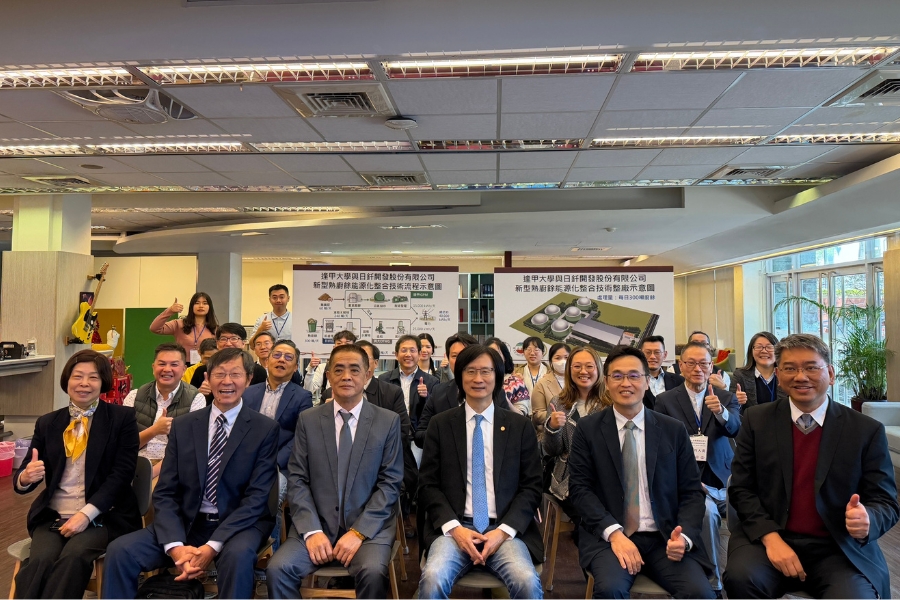
Faculty members of Feng Chia University and executives from Nikkan Development Co., Ltd. pose for a group photo after the signing ceremony, marking an important milestone in industry–academia collaboration.
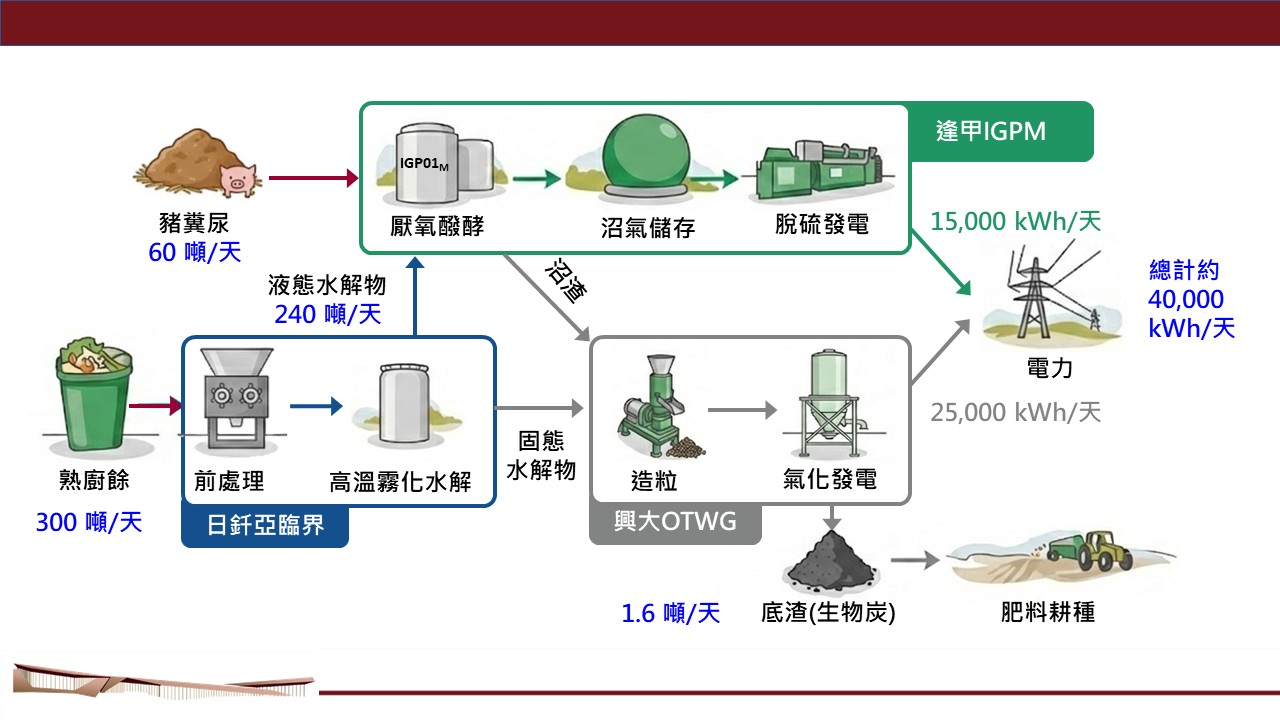
Process Flow Diagram of the New Integrated Technology for Energy Recovery from Cooked Food Waste Developed by Feng Chia University and Nikkan Development Co., Ltd.
Share:
Related News