


Share:
In response to the compound risks and rising challenges brought by climate change, higher education institutions in Central Taiwan have joined forces to take action. On December 19, the Central Taiwan University System (M6) held the “Resilient Taichung, Sustainable Future—M6 Climate Resilience and Sustainability Forum” at the Grand Auditorium of the Virtuosi Hall, Feng Chia University. Co‑organized by Feng Chia University and China Medical University, the forum brought together experts from government agencies, academia, and research institutions to explore how cities can build a more resilient and sustainable future amid escalating climate impacts—from technological disaster prevention and social justice to governance and collective action.
During the opening remarks, Vice-President Eric Kuo‑Hao Tang of Feng Chia University and Vice-President Cheng‑Chieh Lin of China Medical University both emphasized that in an era of increasingly frequent extreme weather, universities must not only be generators of knowledge but also active responders to public issues. They highlighted the responsibility of higher education to connect academic expertise with urban governance and societal needs, thereby amplifying universities’ public impact.
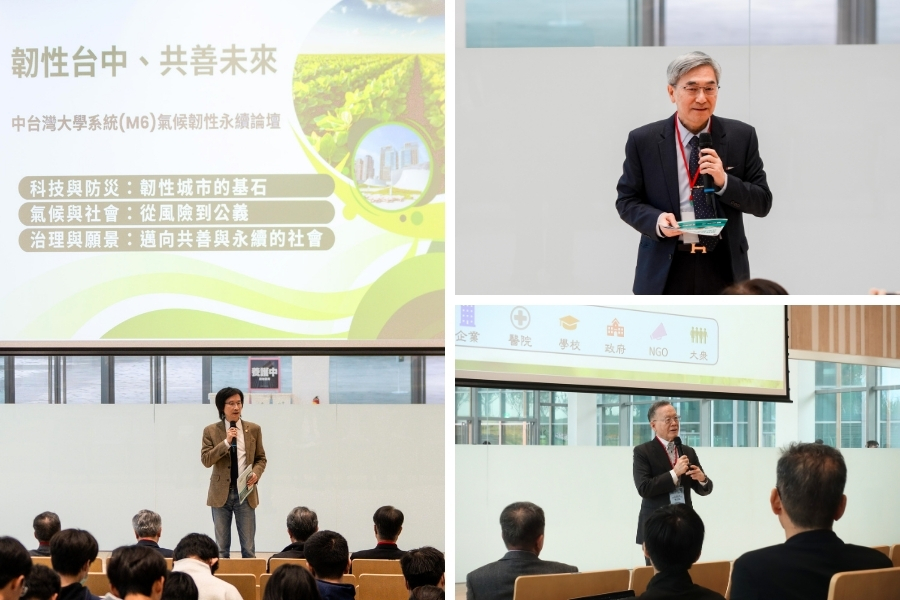
Photo Captions Left: Feng Chia University Vice-President Eric Kuo‑Hao Tang and China Medical University Vice-President Cheng‑Chieh Lin delivering opening remarks on behalf of the organizers. Right (bottom): You‑Hsin Chien, Chairperson of the Taiwan Institute for Sustainable Energy, delivering the keynote speech on climate adaptation and resilient cities.
Technology and Disaster PreventionIn the session on “Technology and Disaster Prevention,” Hong‑Yi Chen, Technical Supervisor of the Taichung City Government, delivered a talk titled “Climate Change and the Challenges and Opportunities of Resilient Cities.” He shared local government strategies and policy frameworks for confronting extreme weather and urban risks.Distinguished Chair Professor Bing‑Chien Lee of Feng Chia University followed with a presentation on “Technological Disaster Prevention and Sustainable Cities,” explaining how technology serves as a key tool in enhancing disaster prevention and resilience governance.Next, Professor Tsu‑Chiang Lei from the Department of Urban Planning and Spatial Information at Feng Chia University delivered a talk titled “Environmental Disaster Prevention Technologies and Disaster Response,” analyzing integrated approaches to disaster response and risk management from academic and practical standpoints.
Climate and Society: From Risk to JusticeThe subsequent session on “Climate and Society: From Risk to Justice” featured Professor Hui‑Tsung Hsu from the China Medical University School of Public Health, who presented “Restoring a Misbalanced Planet—On the Reversibility and Limits of Climate Change,” highlighting long-term impacts of climate crises on human health and ecological systems.Professor An‑Ting Cheng from the Department of Land Economics at National Chengchi University then delivered “From Risk to Resilience—Responding to Energy Transition and Climate Inequality through Land Governance,” stressing that climate policy must incorporate considerations of social vulnerability and climate justice to address unequal risks borne by different communities.
Governance and Vision: From Local Resilience to Global ResponsibilityThe afternoon session shifted to “Governance and Vision: From Local Resilience to Global Responsibility.” You‑Hsin Chien, Chairperson of the Taiwan Institute for Sustainable Energy, delivered the keynote speech titled “Climate Adaptation and Resilient Cities,” offering insights from global governance and international policy perspectives and underscoring the roles cities and higher education institutions play in climate adaptation.
M6 Sustainability Officers RoundtableThe closing session, the “M6 Sustainability Officers Roundtable: Advancing High‑Quality Climate Change Education,” was hosted by Vice-President Jyh‑Horng Chou of Feng Chia University. Sustainability officers from six universities in Central Taiwan joined the discussion, sharing their practical experiences under the joint commitment of the “Climate Change and Sustainability Education Declaration.” The roundtable further explored inter-university collaboration, resource sharing, and curriculum development mechanisms, showcasing the integrated potential and collective direction of the Central Taiwan University System in sustainability education and climate action.
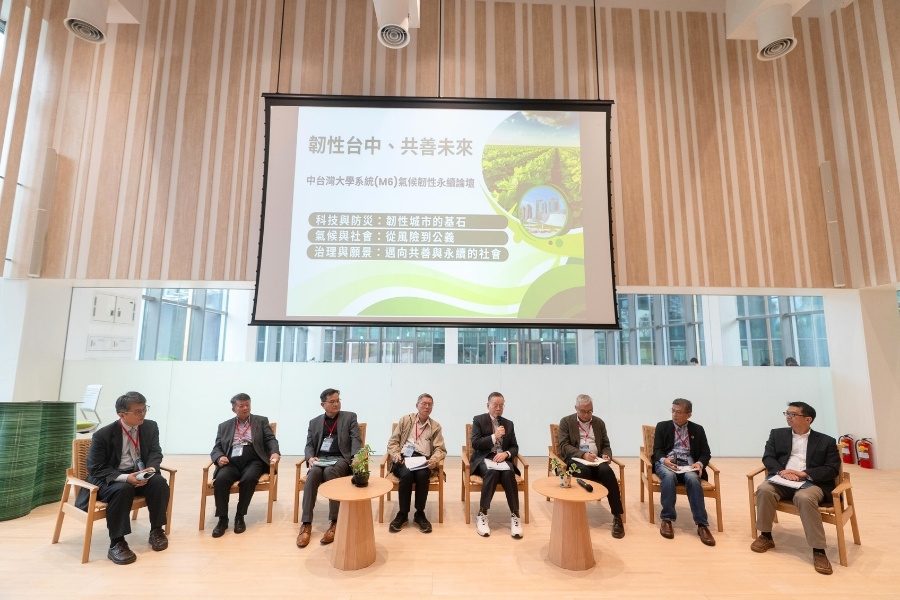
M6 Sustainability Officers Roundtable, hosted by Feng Chia University Vice-President Jyh‑Horng Chou, featured panelists (left to right): Shih‑Yu Chang, Dean, College of Health Management, Chung Shan Medical University; Cheng‑Chun Lee, Chief Sustainability Officer, China Medical University; Shao‑Liang Chang, Deputy Sustainability Officer, Asia University; Jyh‑Horng Chou, Vice-President, Feng Chia University; You‑Hsin Chien, Chairperson, Taiwan Institute for Sustainable Energy; Ho‑Wen Chen, Director, Office of Sustainability and Institutional Research, Tunghai University; Dean Shih‑Hsien Shih, Chief Sustainability Officer, Feng Chia University; Tsun‑Jui Hsieh, Deputy Sustainability Officer, Providence University.
Closing RemarksIn the forum’s concluding remarks, Dean Shih‑Hsien Shih, Chief Sustainability Officer of Feng Chia University, emphasized that the university has long embraced the philosophy of the “Doctrine of the Mean” as its core principle of sustainability—striving for balance across environmental, social, and governance dimensions. He highlighted that true sustainability is not achieved through aggressive slogans but through steady, continuous efforts that accumulate into meaningful change. He further noted that addressing climate change—an inherently complex global issue—requires cross-university, cross-disciplinary, and cross-sector collaboration to collectively build a resilient and sustainable future.
This forum not only served as an important exchange platform for climate resilience curriculum development within the Central Taiwan University System (M6) but also marked a significant milestone in higher education’s partnership with cities and society to respond to climate risks and advance sustainability for the common good.
Share: