


Share:
By Tzu-Feng Tseng
Visiting Professor, Feng Chia University
The Birth and Controversy of Feng Chia’s Virtuosi Hall: A Prelude to a New Era
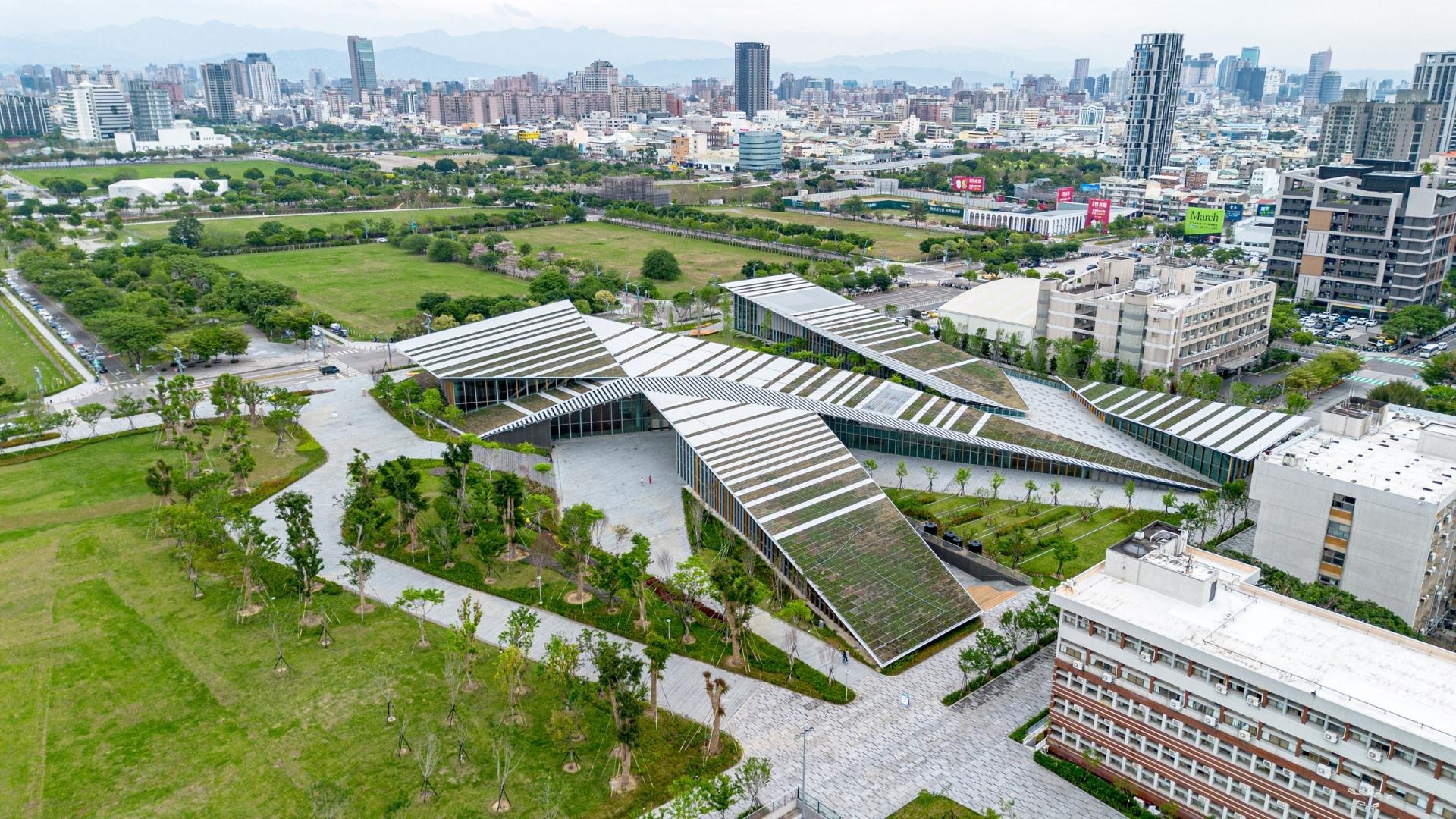
On a Taichung afternoon, sunlight slants through Central Park in Shui-Nan and into Feng Chia University’s new East Gate, where a low-profile yet intricately detailed building comes into view. Grass slopes extend to the roof, wooden lattices breathe light and shadow, and expansive glass blurs the boundary between inside and outside. This is the “Virtuosi Hall,” recently sparking the most debate in Taiwan’s architectural circles.
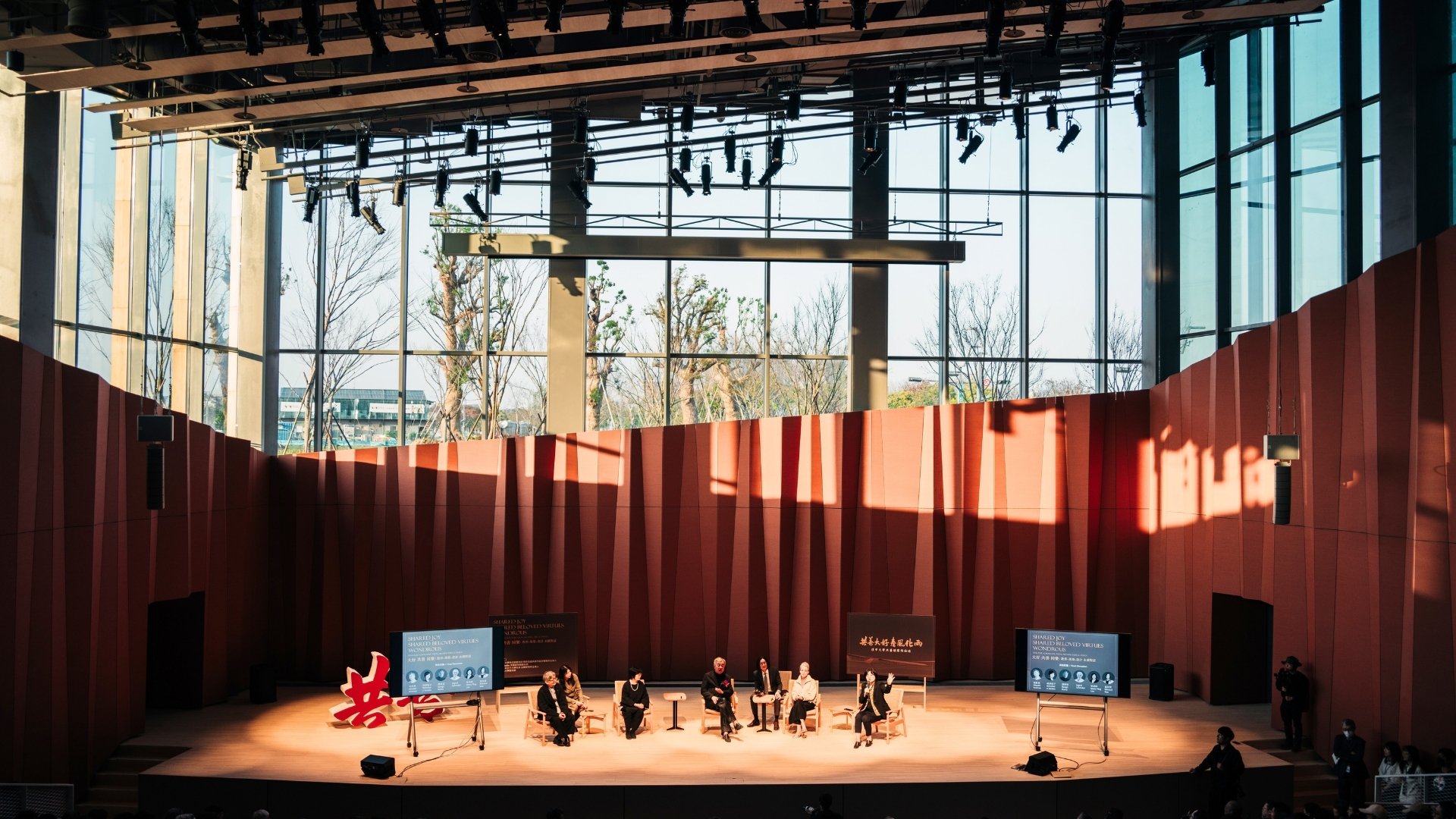
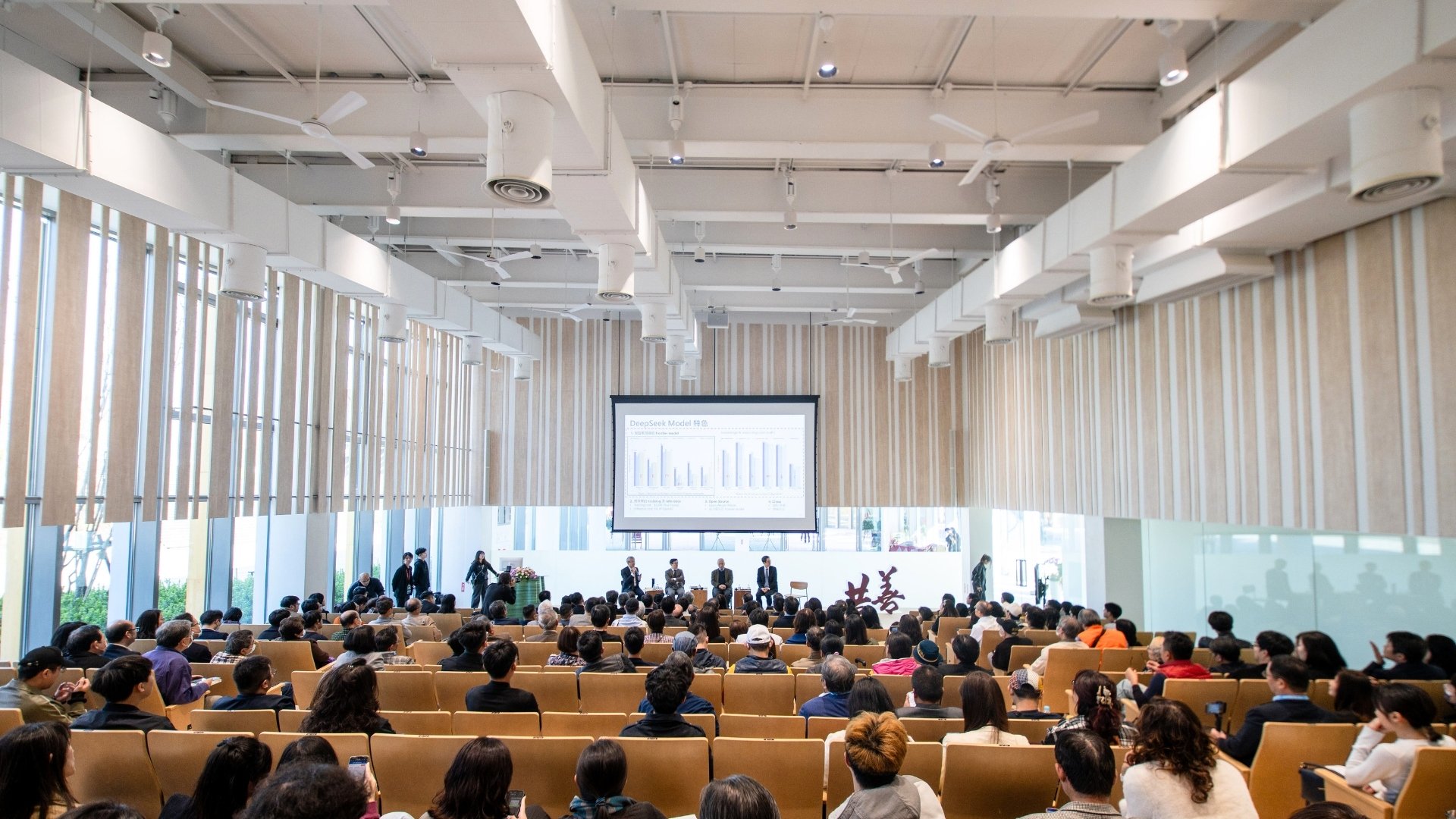
The first impression is both disruptive and eye-catching. It breaks away from the rigid grids of traditional university architecture, resembling instead a terrain sculpted by wind, flowing crowds, and nature. Two low-rise volumes, aligned along an N-shaped axis, connect layered verandas and open courtyards. Slopes, breezeways, atriums, and green gardens weave a rhythm that guides movement. Indoors, glass façades reveal everything—lecture halls, performance spaces, multimedia classrooms, and interdisciplinary hubs—forming a network of freely permeable spaces. This is not a sealed box but an open field woven from lattices, ramps, and light.
In the university’s narrative, Virtuosi Hall embodies a promise of “immersive learning, public culture, and an open campus,” responding to social expectations with values like “shared goodness and transformative education.” Such language is persuasive and reflects Feng Chia’s ambition to express governance ideals through architecture.
Another striking impression comes from the campus’s “park-like” atmosphere. Low-rise volumes and grass-covered roofs merge with surrounding gardens, creating an ecological island where the campus retreats into nature. This evokes one of today’s most pressing urban issues—Urban with Nature. Here, the design conveys ideals of net-zero, resilience, and climate neutrality, reshaping everyday relationships between humans and nature. Kengo Kuma calls it Taiwan’s first “landscape architecture,” echoing his philosophy of “negative architecture”: letting buildings recede and disappear in pursuit of coexistence.
The third impression lies in its astonishing craftsmanship complexity. No two of its 191 steel beams are identical; 1,750 glass panels vary in size; 4,900 wooden lattices combine in thousands of proportions; even the inverted panels exhibit near-infinite variations. For a construction industry accustomed to standardized production, this posed an unprecedented challenge. Some hail it as a pinnacle of BIM and digital modeling fused with local craftsmanship, while others criticize it as a synonym for resource waste, error risk, and maintenance difficulty.
Consequently, public reactions are polarized. Supporters call it the prototype of an “Asian New Bauhaus,” claiming it aligns with digital transformation and sustainability trends. Critics point to the financial risks of massive investment for a private university, the deviation from circular economy principles, and doubts about whether its shared vision will materialize. Even within design circles, some question whether it falls into the trap of self-replication by a master architect.
Yet these controversies reveal its zeitgeist. The evaluation of Virtuosi Hall has never been merely an architectural issue—it is a social issue. It concentrates Taiwan’s tensions in educational transformation, industrial adjustment, and social sharing into a single structure. Critics must admit: it may not be perfect, but precisely because it exposes contradictions so starkly, it deserves to be seen as a mirror of paradigm shifts.
Virtuosi Hall as a Mirror of the Zeitgeist
The term “Zeitgeist” carries profound weight in architectural history. It is not merely an abstract philosophical concept but a formal expression of how an era understands itself and imagines its future. Hegel described it as “the manifestation of reason in every age.” Once it enters the realm of architecture and art, it becomes imprinted in walls, windows, streets, and the fabric of cities.
However, the interpretation of the Zeitgeist has never been a smooth process. It often emerges through intense conflict—tempered in the crucible of debate and controversy.
Historical Perspective: Avant-Garde and Conflict
A century ago, the avant-garde masters of modern architecture stood at the forefront of social upheaval and paradigm shifts, engaging in fierce battles. Through active interpretation of the Zeitgeist, they proposed bold, forward-looking, and integrative solutions.
From the ruins of post-war Europe arose the Bauhaus. Walter Gropius rallied artists and craftsmen under the slogan “Unity of Art and Craft,” seeking a new language for the industrial age. In its brief 19-year history, Bauhaus faced relentless opposition—forced to relocate multiple times and ultimately suppressed in Europe before migrating to the United States. Le Corbusier, with his dictum “A house is a machine for living in,” introduced a new order of rationality and standardization in modern architecture. At the time, critics dismissed these ideas as “cold” and “inhuman.” Yet history proved they truly responded to—and guided—the needs of their era, marking the dawn of modernity.
21st Century Challenges
Today, we stand at another breaking point. This time, the crisis is not the birth of industrialization but the backlash of the environment. Climate change and energy crises make carbon neutrality an unavoidable imperative. Meanwhile, AI, BIM, and big data permeate every corner of life—bringing efficiency but also amplifying anxiety and inequality. Beneath these shifts lie fractures of class, generation, and culture, creating an urgent need for a new “language of empathy.” Old paradigms have collapsed; new ones remain in the fog of uncertainty.
Against this backdrop, Virtuosi Hall takes on profound significance as a manifestation of the Zeitgeist. It is not merely a building but a metaphor where hope and contradiction crystallize together.
Virtuosi Hall as a Mirror Responding to 21st-Century Challenges
We can view Virtuosi Hall as a mirror. When we gaze upon it, we see not only the architect’s ingenuity but also the contradictions of our society and its desires for the future. These desires include:
- Its transparency and openness, symbolizing a longing for openness and exchange;
- Its customized craftsmanship, symbolizing the pursuit of excellence and uniqueness;
- Its green slopes and natural ventilation, symbolizing the hope for sustainability.
Yet, the mirror also reflects contradictions: Does transparency truly lead to sharing? Does exceptional craftsmanship imply resource waste? Can sustainable design be realized within institutional and operational constraints? These questions are not flaws—they are the reality of our time. These tensions are the embodiment of the Zeitgeist, not architectural defects but historical truths.
Compared to modernist masters, Kengo Kuma’s “negative architecture” no longer glorifies industrialization and standardization but responds to environmental and human needs. Virtuosi Hall stands at the other end of this arc: inheriting the logic of digital technology while continuing the grammar of nature. It is a “hybrid” between two paradigms—a reflection of contemporary spirit, where hope is born amid contradictions and uncertainty.
The Emergence of the New European Bauhaus
The “New European Bauhaus” (NEB) is a cultural initiative launched by the EU in 2020 alongside the Green Deal. It is not merely an extension of environmental policy but a historical reinterpretation: under global pressure for circular economy and climate neutrality, Europe once again invokes the symbol of “Bauhaus” to seek a new language for the 21st century.
A century ago, Bauhaus responded to the birth of industrial civilization through standardization and modularity, offering forms for mass production. Today, NEB responds to the environmental crisis brought by industrial civilization. It calls for a shift from linear industrial development to circular economy and sustainable culture—a transformation not just of technology but of civilizational paradigms.
From Paradigm Rupture to Reconstruction: From Linear “Industrial Civilization” to Closed-Loop “Circular Civilization”
Behind NEB lies the European Green Deal, a sweeping circular economy plan by the European Commission. Achieving climate neutrality by 2050 is not merely about reducing carbon emissions—it is a systemic societal transformation toward circularity. Economically, this means moving from the linear logic of “produce–consume–discard” to the closed-loop logic of “repair–regenerate–reuse.” This shift demands comprehensive redesign—energy, industry, architecture, education, and everyday life. In short, humanity’s way of living must be rewritten.
Policy language is often cold—carbon metrics and renewable ratios feel abstract and distant. To mobilize society, a cultural language is needed. Thus, the New European Bauhaus was born.
Three Core Principles of NEB: Sustainability, Beauty, Inclusion
NEB articulates three values as guiding principles for design and social development:
- Sustainable: All design and construction must align with climate neutrality, decarbonization, and circular logic.
- Beautiful: Sustainability must become a desirable experience, not a cold technical mandate.
- Inclusive: Prioritize vulnerable groups to ensure fairness and shared benefits during transition.
These principles are less design rules than civilizational declarations—turning “necessity” into “aspiration,” and “policy” into “everyday life.”
They expand into four thematic axes: reconnecting with nature, rebuilding belonging, prioritizing the vulnerable, and emphasizing life-cycle thinking. NEB’s uniqueness lies not in creating a new style but in embedding sustainability into culture through interdisciplinary collaboration, collective participation, and multi-level governance.
NEB as an Intertextual Framework for Virtuosi Hall
This interpretive lens situates Virtuosi Hall not as an isolated Taiwanese event but as part of a global civilizational shift. If NEB is Europe’s cultural translation of climate neutrality, Virtuosi Hall is Taiwan’s local experiment in facing global transformation.
Analysis of Virtuosi Hall
1.Spatial Form: From “Building” to “Field”
From Feng Chia’s 1990s “Campus as Garden” to today’s Virtuosi Hall, the paradigm shift is clear. Virtuosi Hall breaks the “floor–corridor–classroom” segmentation, adopting slopes, breezeways, and open courtyards as core motifs. Learning unfolds in movement, pauses, and encounters—students discussing on staircases, teachers engaging visitors in corridors, citizens enjoying coffee in the atrium. This ambiguity becomes a new educational language, echoing NEB’s vocabulary: rediscovering belonging and returning to nature. Light and greenery are not mere backdrops—they are part of education. Yet questions arise: Does openness compromise focus? Can traditional quietude survive? These tensions are inevitable tests of a new paradigm.
2.Craft and Construction: Deconstructing Industrial Standards
If spatial form challenges usage logic, Virtuosi Hall’s craftsmanship challenges construction logic. With 191 steel beams, 1,750 glass panels, and 4,900 wooden lattices—almost all customized—it rebels against modernism’s modularity. Supporters hail it as a triumph of craftsmanship and BIM; critics fear resource waste and deviation from circular economy. Historically, this attempt is significant: forcing artisans to relearn, restoring craft’s presence amid efficiency, and integrating life-cycle thinking—precisely NEB’s call for reconnecting nature and interdisciplinary collaboration.
3.Net-Zero and Climate Neutrality: Hidden Potential
By carbon audit alone, Virtuosi Hall is not zero-carbon—complex craft raises energy use, maintenance relies on conventional power. Yet design embeds decarbonization potential: daylight reduces artificial lighting; atriums and ventilation corridors cut cooling demand; green roofs insulate, harvest rainwater, and create habitats. Coupled with energy governance, it could become a carbon-neutral testbed—aligning with NEB’s life-cycle thinking: architecture as long-term governance, not a finished product.
4.Usage and Governance: Brewing a New Social Contract
Virtuosi Hall’s greatest challenge lies not in design but in use. Conceived as a platform for cross-boundary co-creation, it demands cultural shifts: Can teachers abandon traditional classrooms? Will students embrace open learning? Will industries share? Will citizens feel welcome in private campus spaces? Answers are not immediate. Virtuosi Hall’s future hinges on weaving new social networks—touching NEB’s hardest principle: inclusion. Inclusion cannot be drawn on blueprints; it requires long-term social negotiation.
5.Critical Gaze
From an architectural-historical perspective, Virtuosi Hall cannot be judged by functional success alone. Its greatest value lies in revealing Taiwan’s contemporary dilemmas—pursuing excellence while exposing contradictions, offering hope while raising questions. Every lattice, glass pane, and slope speaks a language: declaring that standardized answers no longer suffice, yet new answers remain unclear. Thus, Virtuosi Hall is a “question-poser”—and history often remembers those who dare to pose questions, not those who claim perfect solutions.
Conclusion: From Virtuosi Hall to Taiwan’s New Bauhaus Movement
1.Dialectics of Contradiction
In architectural history, what is remembered is rarely the “perfect” building, but those that truthfully reflect the contradictions of their time. The Bauhaus campus did so as the prelude to modernity; the Pompidou Center likewise embodied the 1970s yearning for publicness. These buildings mattered not because they solved every problem, but because they thrust problems into the public eye.
Virtuosi Hall is no different. Beneath its grassy roof lies more than a teaching facility—it is a metaphor: Taiwan’s higher education caught in fissures, the construction industry struggling between tradition and digitalization, society longing for sharing yet constrained by habit. It concentrates these tensions, forcing us to confront them.
2.A Century-Long Arc
If we extend the timeline, Virtuosi Hall is a node on a century-long arc.
In the 1920s, Bauhaus spoke the language of “industrialization”: architecture became a friend of machines, responding to mass production through standardization.
In the 1970s, the Centre Pompidou spoke the language of “transparency”: amid the atmosphere of the Cold War and student movements, architecture flipped inside and out, becoming a symbol of publicness.
In the 2020s, the EU’s New European Bauhaus (NEB) speaks the language of “circularity”: architecture is seen as part of the life cycle, a carrier of social agreements.
In 2025, Taiwan’s Virtuosi Hall may not bring a complete style or cause an international sensation, but it clearly reflects our contradictions: on one hand, we long to join the global circular transformation; on the other, we are constrained by local systems and industries. It is a hybrid product and a symbol of chaos, and this is precisely our opportunity to connect with the world.
3.The Value of Contradiction
Some may see these contradictions as failure, but from a critical perspective, they are its value. Avant-garde architecture need not be perfect—it must be truthful. Virtuosi Hall exposes fractures between digital modeling and traditional construction, tensions between sustainability slogans and resource realities, gaps between institutional visions and user habits. These are not flaws but materializations of the Zeitgeist. Just as Villa Savoye was once criticized as “cold and impractical” yet became an icon of modern architecture, Virtuosi Hall’s achievement may lie in posing questions.
4.Prelude to a New Civilization
Placed in a global context, the meaning becomes clearer:
Bauhaus was the overture to industrial civilization;
NEB is the herald of circular civilization;
Virtuosi Hall is the echo of this transformation in Taiwan.
It may not become a classic, but it will be remembered, because it embodies Taiwan’s contradictions and hopes, becoming “a fragment of the prelude to Asian circular civilization.”
5.The Critic’s Final Gaze
As you leave Virtuosi Hall and glance back at the light filtering through its wooden lattices, you realize: architecture is not an object that provides answers—it is a medium that brings us to the heart of questions.
Virtuosi Hall does exactly that. It reminds us that the future will not be built on fixed answers but on continuous experiments and inquiries. In this sense, it transcends the category of a university building and becomes a metaphor for our time.
*本文資料轉載自 建築師雜誌 │ TAIWAN ARCHITECT Magazine │ 2025/10
Share:
Related News