

Safeguarding Solar Panels with AI and 5G: Feng Chia University Students Win Honorable Mention in MOE Chip Design Competition
A student team from the Department of Communications Engineering at Feng Chia University, consisting of Yi-Hsuan Tsai, Chun-Han Yang, and Chieh-Tso Lin, under the joint guidance of Associate Professor Ang-Hsun Tsai and Assistant Professor Chi-Han Chen, participated in the 2026 Interdisciplinary Smart Chip Design and Application Innovation Project Competition. Their project, titled "Smart Solar Panel Inspection System Combining 5G and Multimodal Image Recognition," won an Honorable Mention in the Smart Environment category. On August 31, they were invited to attend the 2026 IC Workshop and Competition Award Ceremony, advised by the Ministry of Education and organized by the MOE Interdisciplinary Smart Chip Design Talent Cultivation Program.
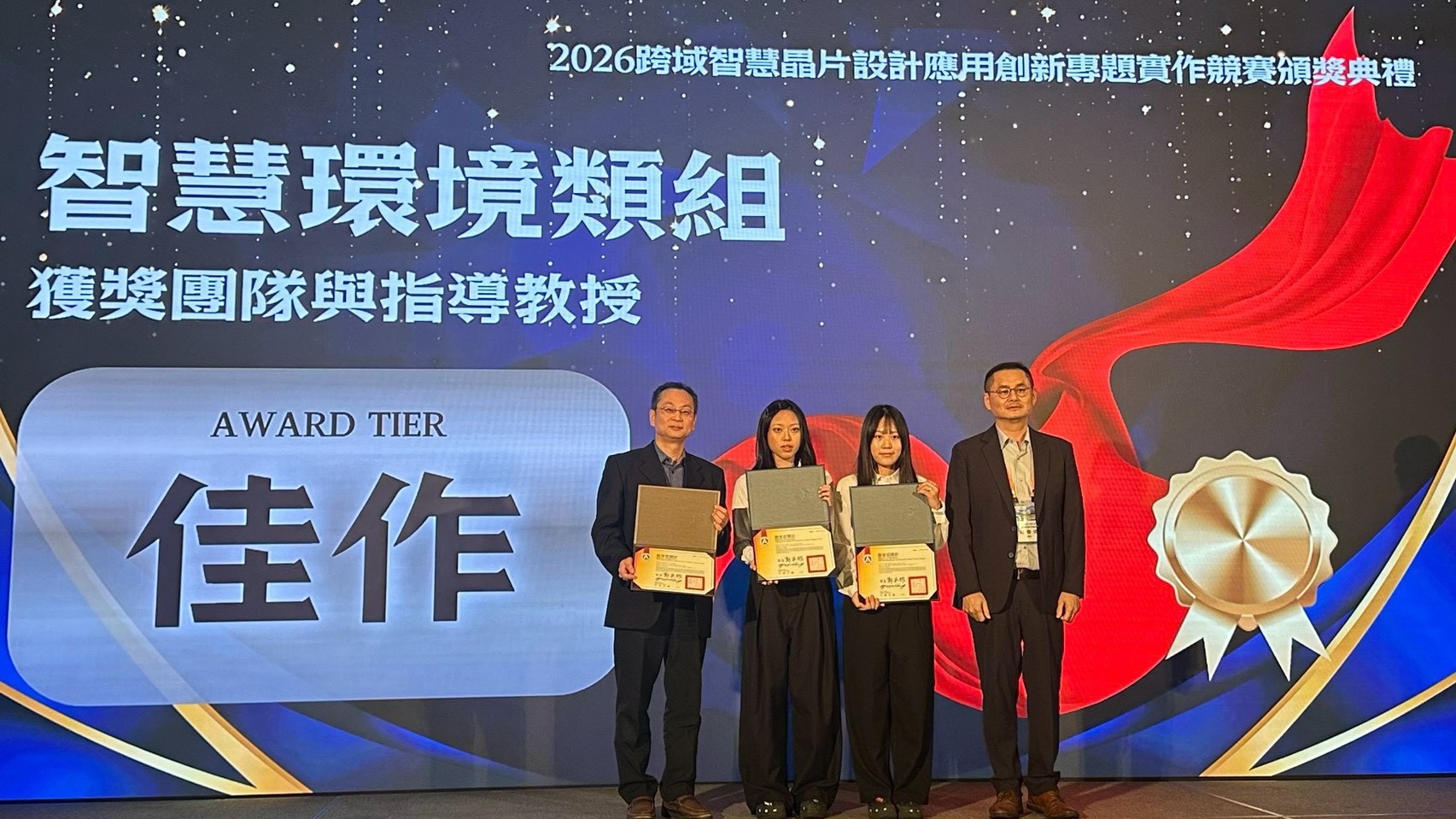
The "PanelVision" team from the Department of Communications Engineering at Feng Chia University received an Honorable Mention in the Smart Environment category of the 2026 Interdisciplinary Smart Chip Design and Application Innovation Project Competition.
The 2026 Interdisciplinary Smart Chip Design and Application Innovation Project Competition was advised by the Ministry of Education, hosted by the College of Engineering at National University of Kaohsiung, and co-organized by the Interdisciplinary Smart Chip Design Promotion Consortium. This year, a total of 163 teams and 468 participants joined the competition, which covered three major application fields: smart health, smart terminal devices, and smart environments.
As photovoltaic fields continue to expand, solar panels exposed outdoors for prolonged periods often suffer from reduced power generation efficiency due to dirt, shading, cracks, or hot spots. Traditional manual inspections are not only time-consuming but also pose certain safety risks, and some hidden defects are difficult to detect in real time. Consequently, the student team integrated 5G communications, drones, visible light and thermal imaging sensors, and artificial intelligence technology. Drones are used to rapidly collect images, which are then analyzed in real time through edge computing for interpretation, classification, and risk grading. The results are integrated into a visualized platform, upgrading the inspection process from simple defect detection to include risk assessment and decision support functions.
Advising Teacher Ang-Hsun Tsai stated that the value of smart technology lies not only in whether a model can identify defects, but more importantly, in whether it can genuinely respond to the needs of users and practical fields. The students also shared that the research and development process of the project was not without its challenges. They faced tests ranging from adjusting the perspectives of heterogeneous lenses and eliminating outdoor reflections to solving web data transmission issues. Through repeated testing and fine-tuning, they realized that project implementation is not merely about pursuing impressive model data, but also about considering system stability, information clarity, and ultimately, whether it can truly help users solve problems.
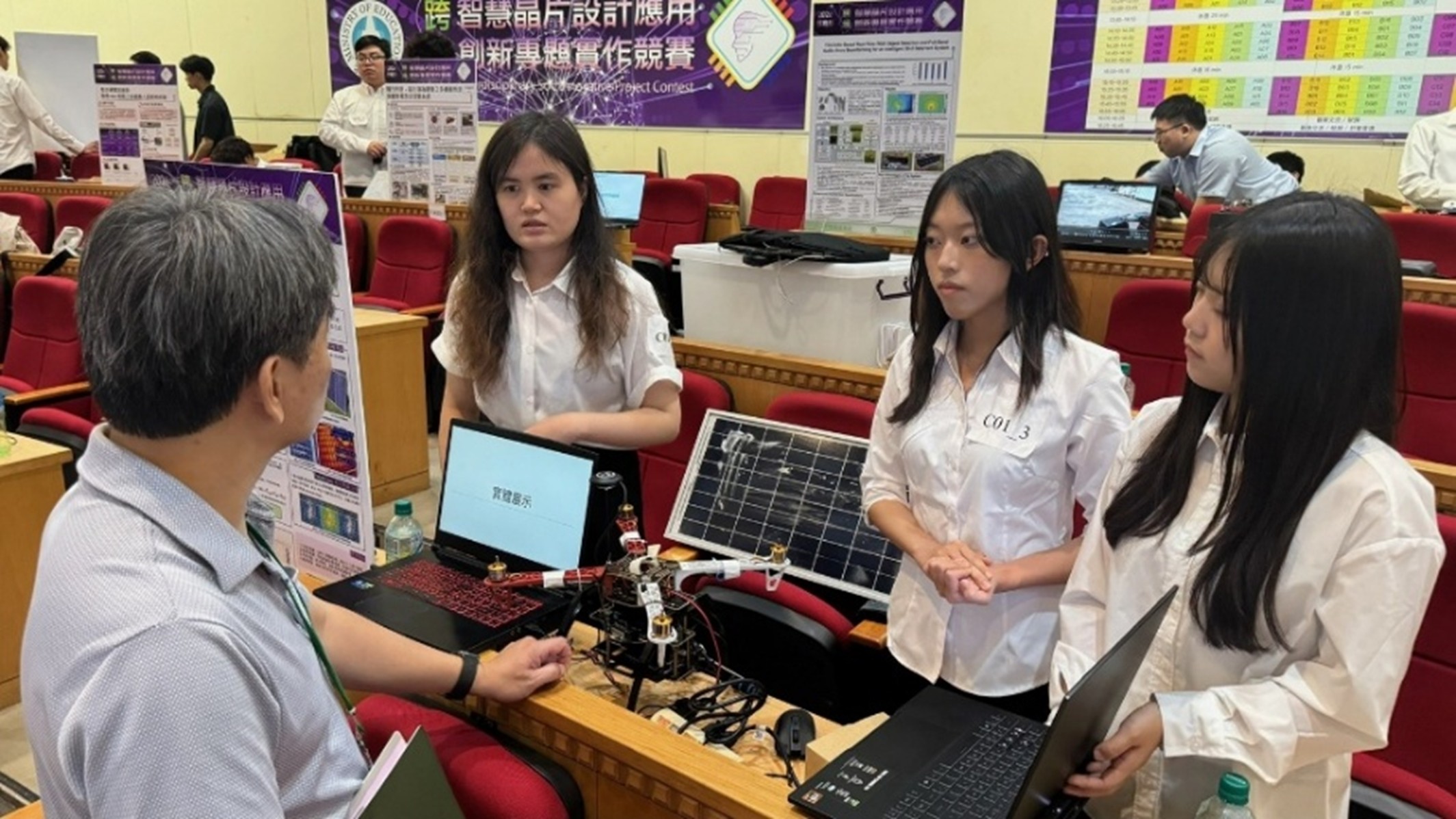
The "PanelVision" team introduced their smart solar panel inspection system to the panel of judges during the finals of the competition.
The Department of Communications Engineering at Feng Chia University has long been dedicated to technological fields such as wireless communications, smart sensing, drones, edge computing, and artificial intelligence, actively encouraging students to accumulate interdisciplinary integration skills through practical projects and competitions. The award-winning student team, PanelVision, will continue to expand data from different fields in the future to enhance recognition stability and optimize risk analysis functions. They hope the system can be applied to various photovoltaic and green energy fields, helping to reduce the burden of inspections and improve the efficiency of anomaly detection.
Share: