

AI for Social Good: Feng Chia University Students Win Second and Third Place in National Millimeter-Wave Radar Competition
Among 85 teams from 16 universities competing in the 2026 Millimeter-Wave Radar AI Creative Application Competition, students from the Department of Information Engineering and Computer Science at Feng Chia University achieved outstanding results. Led by Associate Professor Chun-Hsiu Yeh, four student teams earned second place, third place, an honorable mention, and a finalist award, demonstrating the University's strengths in applying intelligent technologies to real-world challenges.
The competition was jointly organized by the College of Interdisciplinary Industry Innovation at National Taiwan Normal University and CoolTech Co., Ltd., with the awards ceremony held on April 11. Feng Chia University's projects focused on practical applications in assistive technology, healthcare, and medical detection, successfully transforming advanced technology into solutions that address genuine social needs.
The national second-place team, consisting of Ching-Min Huang, Min-Yen Kuo, and Shih-Ming Wang, developed GuideSense, an intelligent navigation assistance system for visually impaired users. By integrating sensing, recognition, and real-time feedback technologies, the project delivered a practical and human-centered solution designed to enhance everyday mobility.
The third-place team, comprising Yuan-Hui Ho, Min-Han Liao, Ming-Yu Lin, and Yi-Ching Wei, developed An Intelligent Sleep Quality Monitoring System Using Millimeter-Wave Radar. Leveraging the non-contact sensing capability of millimeter-wave radar technology, the system improves convenience in daily health monitoring while demonstrating the potential of combining smart sensing with data analytics in healthcare applications.
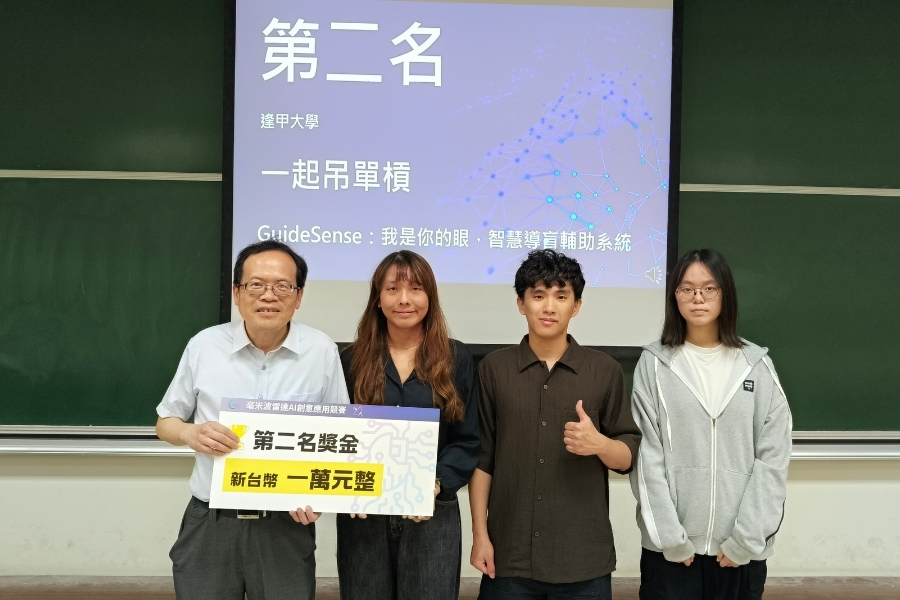
The team of Ching-Min Huang, Min-Yen Kuo, and Shih-Ming Wang from the Department of Information Engineering and Computer Science won second place in the 2026 Millimeter-Wave Radar AI Creative Application Competition with their project GuideSense.
In addition, Cheng-Hsun Lee, Yen-Chieh Shih, Ching-Po Tsao, and Ting-Chieh Yang received an Honorable Mention for their project Great Mother, which focused on specialized caregiving scenarios and developed a human-centered smart support system.
The finalist team, composed of Hsien-Chung Lin, Hsiao-Hsi Lin, and Tzu-Hsuan Fu, presented Trembling in My Heart, a project centered on physiological condition detection and medical-assistance analytics.
All four projects were inspired by real social needs and highlighted the students' strong sense of social responsibility as well as their ability to transform innovative ideas into practical applications.
Associate Professor Chun-Hsiu Yeh emphasized that “AI cannot remain a slogan—it must be implemented in real industrial and everyday-life scenarios.” She noted that millimeter-wave radar has emerged as one of the most promising sensing technologies in recent years. During the competition process, students were required to overcome challenges ranging from problem analysis and system architecture design to data processing and scenario validation. The success of all four teams reflects the effectiveness of Feng Chia University's educational efforts in intelligent sensing and AI application development.
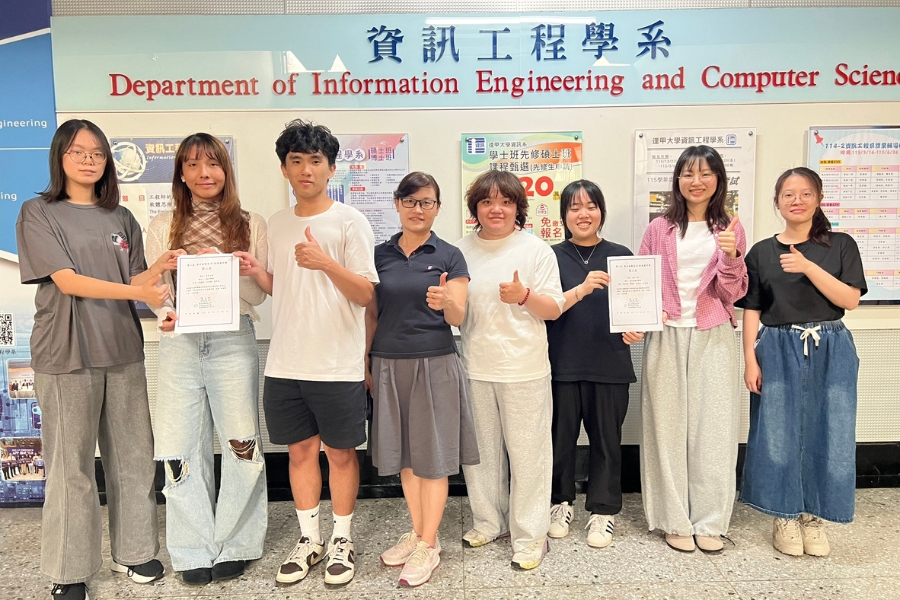
Under the guidance of Associate Professor Chun-Hsiu Yeh (fourth from left), four Feng Chia University student teams competed in the event and earned second place, third place, an honorable mention, and a finalist award.
The Department of Information Engineering and Computer Science at Feng Chia University has long been committed to teaching and research in artificial intelligence, intelligent sensing, and system integration. The department actively encourages students to participate in external competitions, allowing them to gain hands-on experience, broaden their perspectives, and strengthen their professional capabilities through practical challenges.
The outstanding achievements in the 2026 Millimeter-Wave Radar AI Creative Application Competition once again highlight the department's excellence in emerging technology applications and interdisciplinary innovation. Looking ahead, the department will continue cultivating talent in smart technologies and aims to achieve further success in future competitions and real-world applications.
Share: