
FCU Team Develops AI-Based Cardiac Imaging Recognition Technology, Wins Merit Award at AI CUP
Taiwan’s largest artificial intelligence competition, the Ministry of Education AI CUP Competition, held its awards ceremony on March 25 at the International Conference Hall of Academia Sinica. A student team from the Department of Information Engineering and Computer Science at Feng Chia University, led by Professor Pei-Jung Lin, earned the Merit Award in the competition category“Cardiac CT Image Segmentation II – Aortic Valve Object Detection.” The team, consisting of Hsiao-Yun Liu, Chia-Hao Lin, Hsiang-Yu Wen, and Chih-Cheng Wei, stood out among 536 teams nationwide to achieve this remarkable result.
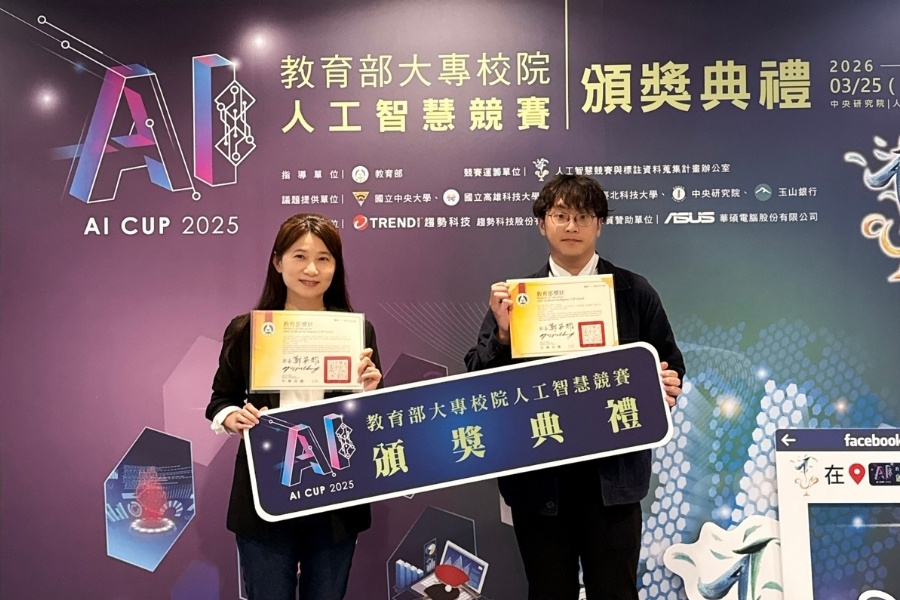
The Feng Chia University team from the Department of Information Engineering and Computer Science received the Ministry of Education Merit Award in the“Cardiac CT Image Segmentation II – Aortic Valve Object Detection” competition, becoming the only private university team among the top six award-winning teams nationwide.
Over its eight-year history, AI CUP has attracted more than 27,000 participants, with approximately 4,600 competitors taking part this year. The medical imaging challenge focused on the automatic segmentation of cardiac muscle structures and aortic valves from computed tomography (CT) images.
Faced with challenges such as small target sizes, blurred boundaries, and substantial variations among medical images, the Feng Chia team discovered that a single model struggled to achieve both precise structural recognition and stable performance. To overcome these limitations, the team proposed a multi-model ensemble strategy as the core solution, successfully addressing the difficulties of detecting small anatomical targets.
The students trained and integrated multiple AI models with different architectures and combined their predictions through a weighted fusion approach. This allowed the models to complement one another, significantly improving overall detection accuracy and robustness. The team also enhanced performance through data filtering and augmentation techniques, training parameter optimization, and comparisons among different model versions. Through this process, they gradually strengthened the system’s ability to identify subtle anatomical structures and ultimately established a highly accurate and reliable medical image analysis workflow.
As a result, the system maintained strong performance even under complex medical imaging conditions and achieved outstanding results in the national competition.
Professor Pei-Jung Lin noted that the team invested significant time in model design and repeated experimentation from the early stages of the competition. Continuous optimization of data processing methods and training parameters, along with extensive technical discussions, contributed to the project’s success.
She added that the achievement demonstrates the team’s ability to integrate expertise in artificial intelligence and medical imaging. Looking ahead, the team will continue advancing related research and promoting practical AI applications within the field of smart healthcare.
Share: